Hair Transplant Aftercare: The Clinical Continuum of Care

Updated: Jun 8

In aesthetic medicine, there is a common misunderstanding that the surgical procedure itself is the finish line. Patients often focus on the day of surgery as the moment the journey is complete. In reality, from a biological perspective, the surgery is only the beginning.
The extraction and implantation of grafts create the architectural foundation of the result. What happens after that determines how securely the grafts settle, how the scalp recovers, and how the final result matures over time. Hair transplant aftercare is not a secondary concern or a list of suggestions. It is an active phase of the medical treatment itself.
At Eva Estetica, we view aftercare as a strict clinical continuum. Healing is not a pause between surgery and results; it is the biological process that allows the design to become permanent. Understanding the physiological mechanics of this process helps patients recover with absolute confidence and actively protect their long-term outcome.
Achieving a flawless, dense result depends entirely on a structured hair transplant aftercare protocol. At Eva Estetica, we treat post-operative recovery as an active continuation of clinical treatment—governed by the biology of plasmatic imbibition and neovascularization. From strategic sleeping positions and epidermal hydration to mechanical tissue exfoliation and navigating shock loss, this comprehensive guide ensures your permanent grafts anchor securely and mature flawlessly.
Table of Contents: Hair Transplant Aftercare
[The Biology of the Graft: Understanding FUE and DHI Aftercare]
[The Biological Partnership: Nutrition and Cellular Healing in the Donor Area]
[Weeks 3 to 8: The Reality of Telogen Effluvium (Shock Loss)]
[The Architecture of Calm: Luxury Hair Transplant Recovery in Istanbul]
[Logistics as Clinical Support: Seamless Travel for International Patients]
[The Milestone Method: Your 12-Month Hair Transplant Timeline]
The Biology of the Graft: Understanding FUE and DHI Hair Transplant Aftercare

When a follicular unit is extracted from the donor area and placed into the recipient site, it is temporarily separated from its original blood supply. It enters a state of mild ischemia (oxygen deprivation). During the first 72 to 96 hours, the graft survives purely by absorbing oxygen and nutrients from the surrounding interstitial fluid—a delicate survival mechanism known as plasmatic imbibition.
Simultaneously, the body begins racing to reconnect the blood supply. New microscopic blood vessels form around the graft to restore a permanent flow of oxygen. This process is known as neovascularization. Until this vascular connection is fully established, the graft remains incredibly fragile.
Pressure, friction, or unnecessary movement can sever these newly forming capillaries. Every aftercare instruction during this critical window is designed to protect this sensitive biological connection.
Sleeping Position and Edema Management
During surgery, local anesthetic and sterile saline fluids are introduced into the scalp. After the procedure, gravity will naturally pull this lymphatic fluid downward, which can cause temporary edema (swelling) across the forehead or around the eyes.
To mitigate this, patients are mandated to sleep with their head elevated at a 45-degree angle for the first five to seven days. This upright position utilizes gravity to support lymphatic drainage, reduces internal pressure on the healing scalp, and ensures the recipient area never experiences friction against a pillowcase.
Epidermal Hydration
The scalp must not be allowed to dry excessively in this early phase. Gentle hydration supports the epidermis as it heals and prevents the formation of thick, restrictive scabs that can suffocate the grafts. A sterile saline solution is utilized to maintain a controlled, clean, and moist environment while the tissue stabilizes.
Want to explore the exact extraction mechanics that happen right before the healing phase begins? Read our complete guide: [Advanced FUE and DHI Hair Transplants in Istanbul]
Days 5 to 14: The Mechanics of Tissue Exfoliation

By the fifth day, the vascular connections are forming, and the scalp moves into the next phase of recovery. The micro-incisions naturally form scabs around the implanted follicles. While these scabs temporarily protect the tissue, they must eventually detach to prevent microbial buildup and allow the scalp to breathe.
The Washing Protocol
Washing during this stage must be strictly mechanical but gentle. Water should be lukewarm; excess heat triggers inflammation. High-pressure water streams from a showerhead must be avoided entirely. Water should be poured gently from a cup. A mild, clinic-approved foam is applied to support healing without chemical irritation.
Safe Scab Removal
Around the eighth day, patients are guided to begin gently massaging the scalp using only the pads of their fingertips (fingernails must never be used) in soft, circular motions. This delicate exfoliation clears the scalp of dried tissue, allowing the follicles to continue their natural healing cycle unobstructed.
By the 14-day milestone, the visible scabs should be completely cleared. The tissue will appear calmer, and the grafts are now permanently locked and anchored into the dermis.
The Biological Partnership: Nutrition and Cellular Healing

While the recipient area commands most of the attention, the donor area—the biological vault at the back of the head—also requires dedicated recovery. It has just sustained thousands of microscopic extractions.
Healing this localized trauma requires immense cellular energy, which is why your internal health must actively support your external recovery. Staying thoroughly hydrated and maintaining a diet rich in lean proteins, iron, and key micronutrients (such as Vitamin C and Zinc) fuels collagen synthesis and accelerates tissue regeneration from the inside out.
As these micro-incisions close and the severed nerve endings begin to rapidly regenerate, patients frequently experience itching, mild tightness, or localized sensitivity. While this sensation can be annoying, it is actually a highly positive biological signal of active cellular repair.
The primary clinical rule: The donor area must not be scratched under any circumstances.
Scratching introduces microscopic bacteria from your fingernails into vulnerable healing tissue and physically disrupts the natural closure of the skin. If soothing foams, saline sprays, or aloe-based products are recommended by the clinical team, they should be applied exactly as directed. These therapies are specifically designed to safely calm the nervous system's histamine response and keep the epidermis supple while the donor tissue recovers its native density.
Weeks 3 to 8: The Reality of Telogen Effluvium (Shock Loss)
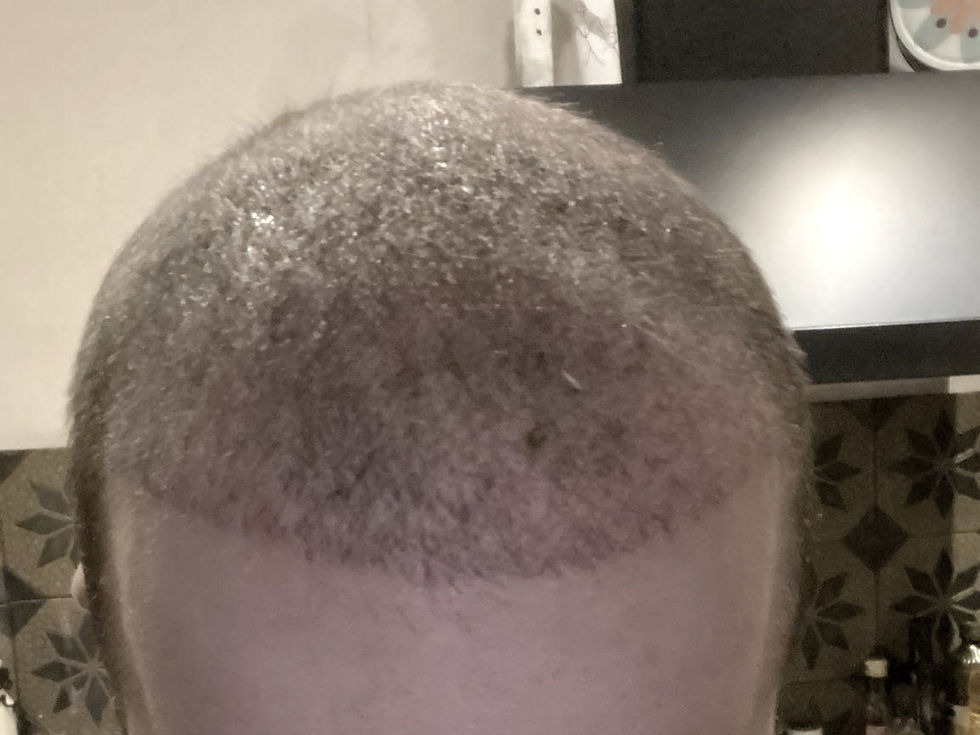
After the grafts are securely anchored and the scalp has visually healed, patients enter the most emotionally challenging phase of recovery. The transplanted hair shafts will begin to shed.
This phase is clinically known as Telogen Effluvium, commonly referred to as "Shock Loss." It is a normal, unavoidable biological reaction. The trauma of surgical relocation forces the follicle to pause and enter its resting phase (telogen). The visible hair shaft disconnects and falls out.
For many patients, this can be concerning, as the scalp may look exactly as it did prior to surgery. However, the transplant has not failed. The critical root—the biological factory—remains securely locked beneath the skin. It is simply resting, gathering cellular energy before it begins to synthesize a brand-new, permanent hair shaft.
Why Shock Loss Happens
The follicle is reacting to the stress of relocation. It pauses, enters dormancy, and later begins producing new hairs. This is part of the natural hair cycle.
The important point is that the root remains in place. What falls out is the old shaft, not the future of the graft.
What Patients Should Expect
This stage can feel slow, but it is not a setback. It is the transition between surgery and regrowth. Clear communication during this period matters because it helps patients stay calm and realistic while the follicles prepare for the next phase.
Want to map out exactly when your hair will grow back thick and dense after the shedding phase concludes? Read our complete guide: [Decoding the Hair Transplant Growth Timeline: A Month-by-Month Breakdown]
Clinical Lifestyle Restrictions and Environmental Hazards

The recovery period is heavily defined by what a patient actively avoids. The scalp is recovering from a complex medical procedure and must be protected from environmental stress.
Strenuous Physical Strain: Heavy lifting, intense cardio, and activities that sharply raise the heart rate must be avoided for at least 30 days. Elevated blood pressure can force blood up into the healing scalp and mechanically push unanchored grafts out of their channels.
Vasoconstrictors (Nicotine): Nicotine physically constricts blood vessels. Because the survival of the grafts depends entirely on restoring blood flow (neovascularization), restricting circulation through smoking or vaping starves the follicles of oxygen and drastically lowers survival rates.
Thermal Trauma: The healing scalp must be protected from intense UV exposure, saunas, and steam rooms. Excessive heat irritates the delicate tissue, while heavy sweating introduces bacteria into the healing environment.
The Architectural Maturation Timeline
Recovery Phase | Clinical Timeline | Biological Milestone |
The Anchoring | Days 1 to 14 | Plasmatic imbibition, neovascularization, and tissue exfoliation. Grafts become permanently secure. |
The Dormancy | Weeks 3 to 8 | Telogen effluvium (Shock Loss). The visible hair shafts shed while the roots rest beneath the scalp. |
The Awakening | Months 3 to 4 | The early anagen phase begins. Fine, translucent hairs emerge from the scalp. |
Structural Thickening | Months 6 to 8 | Hair shafts increase in caliber and pigment. The geometric framing of the face becomes clearly visible. |
Final Refinement | Months 12 to 18 | The architecture reaches full maturity. Texture and density seamlessly match the native canopy. |
The Architecture of Calm: Luxury Hair Transplant Recovery in Istanbul

We recognize that the environment in which you heal profoundly influences the physical healing process itself.
Stress elevates cortisol levels, which in turn constricts blood vessels. Vasoconstriction limits the amount of oxygen and nutrient-rich blood reaching the scalp, which can impede optimal recovery and prolong the inflammatory phase. Therefore, absolute tranquility is not merely a luxury at Eva Estetica it is a physiological necessity.
Our private patient suites in Istanbul are purposefully designed to foster this tranquility. We step away from the chaotic, and rushed atmosphere typical of high volume hair transplant centers in Turkey. Instead, our spaces are thoughtfully appointed to provide a quiet sanctuary. Warm lighting, subtle textures, and considered layouts create an environment where comfort feels effortless and privacy is absolute.
This unhurried pacing extends to our scheduling. By strictly limiting our daily case volume, we ensure that our medical professionals are never rushing to move on to the next room.
This allows our patients to rest adjacent to the procedure room, ask questions without feeling a sense of urgency, and transition into the recovery phase with quiet confidence.
Logistics as Clinical Support: Seamless Travel for International Patients

For our international patients traveling to Istanbul for a hair transplant, the stress of navigating a foreign city, managing luggage, and coordinating transportation can easily trigger the cortisol response that undermines the calm required for optimal recovery.
True comfort is quiet; it means the medical procedure is the only thing you need to focus your energy on.
To achieve this, we have integrated our logistical operations directly into our care model.
Our private VIP transfer and chauffeur services handle every movement with first-class discretion. From the moment you arrive at the airport, your journey is mapped and managed. Professional drivers, quiet routes, and coordinated pick-ups ensure that your transition between our Istanbul team and your hotel is seamless. There is no waiting for taxis on a busy street, no struggling with heavy bags, and no logistical anxiety.
Furthermore, we partner exclusively with curated luxury accommodations in Istanbul. These hotels are selected not only for their aesthetic appeal but for their proximity to our team, their tranquility, and their discreet service. Private check-ins and rooms designed for quiet rest harmonize perfectly with your clinical schedule. This seamless integration ensures that your environment remains controlled, comfortable, and highly conducive to healing from the moment you land until the moment you depart.
Preparing to fly to Istanbul for your procedure? Discover exactly how our concierge team eliminates travel anxiety and orchestrates every detail of your VIP experience in our comprehensive guide: [The International Patient Travel Guide]
The Milestone Method: Your 12-Month Hair Transplant Timeline

Perhaps the greatest flaw in the broader hair transplant industry is the concept of the "handoff." A patient undergoes surgery, returns to their home country, and is effectively left to navigate the next twelve months entirely alone.
At Eva Estetica, there are no handoffs. There is only continuity.
The maturation of a hair transplant result is a slow, deeply subtle process.
Because we view this journey as a long-term dialogue, we remain personally involved long after you have returned home.
We employ a structured, milestone-based follow-up protocol. Through remote photographic check-ins and scheduled clinical consultations, our team monitors your progress at exact intervals, mapping your recovery against expected biological timelines.
The standard hair transplant timeline is generally structured as follows:
Weeks 2 to 4 (The Shedding Phase): Often the most psychologically challenging phase, known as "shock loss." The transplanted hairs shed their shafts while the root remains secure beneath the skin. Our team is present to reassure patients that this is a healthy, expected part of the follicular cycle.
Months 3 to 4 (The Awakening): The first fine, translucent hairs begin to emerge. They are often delicate and lack pigment, but they signal the beginning of visible hair restoration.
Months 6 to 8 (Structural Maturation): The new hair begins to thicken, change in caliber, and take on its natural texture. At this stage, the architectural framing of the face becomes apparent, and the illusion of density begins to solidify.
Months 12 to 18 (The Final Polish): The hair transplant result reaches full maturity. The grafts have fully settled, the texture matches the native hair entirely, and the subtle, age-appropriate design we mapped on day one is fully realized.
This ongoing, milestone-based dialogue serves several vital purposes. It allows us to monitor scalp health and address any minor concerns such as dry skin or unexpected shedding patterns long before they become issues.
More importantly, it provides accountability. We stand firmly behind our artistry. Tracking your progress over a year ensures that the precise, dignified design we planned during your initial consultation is coming to fruition exactly as intended.
Healing as a Partnership at Eva Estetica Istanbul

True expertise does not announce itself with volume, nor does it disappear the moment the surgery concludes. It reveals itself in precision, in proportion, and in a steadfast, uncompromising commitment to the final outcome.
A beautifully designed, age-appropriate hairline crafted with strict adherence to donor stewardship and executed using the most refined FUE or DHI hair transplant techniques is a biological investment that deserves to be meticulously protected. By providing an environment of absolute calm, seamlessly managing every logistical detail to reduce travel stress, and maintaining a rigorous, year-long continuum of care, we ensure that your investment is permanently secured.
At Eva Estetica Istanbul, we do not view you simply as a patient for a day. We view you as a partner in a long-term process of restoration. The surgical procedure is merely the beginning of the design. The healing is where the art truly settles, matures, and becomes an undetectable, enduring part of you.
Conclusion: The Mark of Enduring Artistry
Ultimately, the distinction between an ordinary hair transplant and an exceptional one lies in the details that unfold long after the procedure room doors close. Meticulous aftercare is not merely an optional service or a luxury amenity; it is the essential safeguard of your biological investment. It is the quiet, steadfast commitment that ensures the precise architecture we map on day one translates seamlessly into the decades ahead.
When you entrust your restoration to a team, you are not simply purchasing a one day procedure. You are entering into a real partnership. If you are seeking a team that values the integrity of your donor hair, respects the natural anatomy of your face, and approaches your healing with the exact same rigorous precision as the surgery itself, we invite you to begin the conversation.
FAQ: Hair Transplant Aftercare & Recovery Protocols
1. How should I sleep after a hair transplant?
For the first 5 to 7 days, you must sleep on your back with your head and neck elevated at a 45-degree angle. This elevation prevents venous pooling, drastically reducing facial swelling, and ensures your newly implanted grafts do not rub against the pillowcase.
2. When can I wash my hair normally after the procedure?
During the first 4 days, the scalp is only hydrated with a sterile saline spray. From days 5 to 14, you will gently wash the scalp using a cup of tepid water and a mild clinical shampoo to remove scabs. After 14 days, once the grafts are securely anchored, you may return to your normal showering routine.
3. When is it safe to wear a hat or a helmet?
You must avoid all headwear for the first 10 to 14 days. Wearing a hat, beanie, or hard helmet creates physical friction that can easily dislodge the fragile grafts before their blood supply has successfully reconnected.
4. When can I go back to the gym or lift weights?
Strenuous exercise, heavy lifting, running, and cycling must be strictly avoided for 20-30 days post-surgery. High-intensity exercise causes massive spikes in blood pressure, which can force blood up into the scalp and "pop" the unanchored grafts out of their incisions.
5. Why did all my transplanted hair fall out after two weeks?
This is a perfectly healthy, expected biological process known as "Shock Loss." The trauma of the relocation causes the follicle to enter a dormant phase, shedding the visible hair shaft. Do not panic; the critical root remains permanently anchored beneath the skin and will begin producing new hair in 3 to 4 months.
6. Can I go in the sun or use a sauna during recovery?
No. Direct UV exposure on a healing scalp can cause permanent hyperpigmentation (dark spotting) on the skin. Saunas and steam rooms induce heavy sweating, which introduces bacteria into the open incisions. Both must be strictly avoided for at least one month.
7. What is the purpose of the saline spray provided after surgery?
The sterile saline solution provides critical hydration to the epidermis during the first few days. It prevents severe scabbing, relieves itching, and provides a clean, moist environment that accelerates the neovascularization (blood vessel connection) of the grafts.
8. At what point are the grafts permanently secure in my scalp?
The grafts are generally considered permanently locked and biologically secure by day 10 to 14. At this point, the microscopic incisions have fully healed, the blood supply has connected, and the grafts cannot be dislodged by normal washing or touching.
9. Can I drink alcohol or smoke after a hair transplant?
Nicotine and alcohol must be strictly avoided. Nicotine is a vasoconstrictor that shrinks blood vessels and chokes the grafts of oxygen, leading to tissue death. Alcohol thins the blood and increases the risk of prolonged bleeding and swelling.
10. Why is my forehead swollen after the procedure, and is it normal?
Mild to moderate swelling (edema) across the forehead and around the eyes is a normal physiological response to the local anesthesia and fluids used during surgery. It typically peaks on day 3 or 4 and subsides naturally. Sleeping at a 45-degree angle helps gravity drain this fluid quickly.
Academic Sources and Clinical Literature
The post-operative recovery timelines, physiological cleaning steps, and graft survival frameworks discussed in this guide are deeply rooted in peer-reviewed surgical literature. For further reading on the cellular mechanics of tissue repair following hair restoration, please consult the following texts:
1. Hair Transplantation: Surgical Safety, Complications, and Postoperative Protocols Zito PM, Raggio BS. StatPearls Publishing (2024). Hosted by NCBI Bookshelf (United States) An authoritative clinical medical education text detailing the physiological steps of hair transplant recovery. This literature outlines strict guidelines for patient aftercare, explicitly explaining why head elevation, swelling management, and controlled graft hydration are medically necessary to prevent complications during the first week of tissue repair.
View on NCBI Bookshelf: https://www.ncbi.nlm.nih.gov/books/NBK547740/
2. Complications in Hair Transplantation: Managing the Healing Scalp Kerure AS, Patwardhan N. Journal of Cutaneous and Aesthetic Surgery (2018). Hosted by Europe PMC (European Union) A comprehensive peer-reviewed surgical safety review that explores the risks associated with improper aftercare. The literature explicitly outlines the critical timing required for safe scab removal, warning that aggressive scratching or premature removal can dislodge anchored follicular units and trigger localized infections.
View on Europe PMC: https://europepmc.org/article/PMC/PMC6371733
3. Follicular Unit Extraction: Minimally Invasive Surgery for Hair Transplantation Rassman WR, Bernstein RM, et al. Dermatologic Surgery (2002). Hosted by NCBI / PubMed (United States) The landmark surgical study that established the micro-physiological parameters of modern FUE. This paper details the biological fragility of newly relocated grafts, providing the clinical foundation for why physical friction, strenuous physical strain, and high blood pressure must be avoided while capillaries undergo neovascularization.
View on PubMed: https://pubmed.ncbi.nlm.nih.gov/12174065/
4. Is Every Patient of Hair Loss a Candidate for Hair Transplant? Deciding Surgical Candidacy Garg S, Garg S. Indian Journal of Plastic Surgery (2021). Hosted by Europe PMC (European Union) A thorough clinical analysis exploring long-term recovery dynamics and patient stability. This research validates the medical timeline of post-operative shedding, reassuring patients that the temporary reality of Telogen Effluvium (shock loss) is a healthy, expected part of the follicular renewal loop.
View on Europe PMC: https://europepmc.org/article/PMC/PMC8719975


Comments