The Master and the Instrument: A Guide to Modern Hair Restoration Technology

Balanced, practical, and patient-first

In the globally expanding field of hair transplantation, technical terminology frequently dominates the conversation. When a patient begins researching their restoration options, they are immediately introduced to an array of clinical acronyms: FUE, DHI, Sapphire blades, Choi Pens, and motorized micro-punches.
These terms are often presented as standalone solutions, creating an assumption that the technology itself is the artist. There is a common misconception that simply selecting a "Sapphire FUE" or "DHI" procedure inherently guarantees a flawless, natural-looking result.
From a clinical perspective, this is a fundamental misunderstanding of surgical reality.
In elite aesthetic medicine, technology is an enabler, not a substitute for human judgment. The most advanced surgical instruments in the world cannot independently analyze facial proportions, calculate the mathematics of a natural whorl, or exercise the ethical restraint required to protect a finite donor area.
To achieve a hair transplant result that is truly undetectable, a patient must understand the precise role that modern technology plays in the procedure. It is designed to minimize trauma, accelerate cellular healing, and increase the mechanical fidelity of execution—but it is always the clinical architect wielding the instrument who dictates the final outcome.
Table of Contents
The Evolution of Modern Hair Restoration Technology: From Strip Surgery to FUE

To properly understand the role of technology today, it is essential to ask a foundational question: What is medical science in the context of hair restoration?
Science is not a static set of rules; it is a continuous evolution toward less invasive, more biologically respectful methods. Medical technology evolves because our understanding of human tissue deepens. A perfect historical example of this evolution is the transition from FUT (Follicular Unit Transplantation) to modern extraction techniques.
Two decades ago, FUT—often referred to as "strip surgery"—was universally recognized as the gold standard of hair restoration. The procedure involved surgically excising a long strip of scalp from the back of the head, suturing the wound closed, and dissecting the strip under microscopes to harvest the follicles. At the time, this was the pinnacle of medical technology. It yielded excellent growth and allowed surgeons to move large amounts of hair.
However, FUT came with a significant biological trade-off: a permanent linear scar across the occipital scalp, longer recovery times, and altered skin tension in the donor area.
As medical science evolved, the field shifted toward FUE (Follicular Unit Extraction). Instead of removing a continuous strip of tissue, surgeons developed micro-punches to extract individual follicular units one by one. This technological leap did not change the biology of the hair follicle; it simply changed the mechanism of delivery. It respected the patient's anatomy, eliminating the linear scar and dramatically reducing recovery time.
This historical shift highlights a crucial point: technology changes, but human biology does not. The tools we use today—Sapphire blades, Choi pens, and micro-motors—are simply the modern iterations of this ongoing scientific evolution. They are refined instruments designed to interact with the scalp as gently and efficiently as possible.
Objective Data: How AI and Micro-Surging Shape Modern Hair Restoration
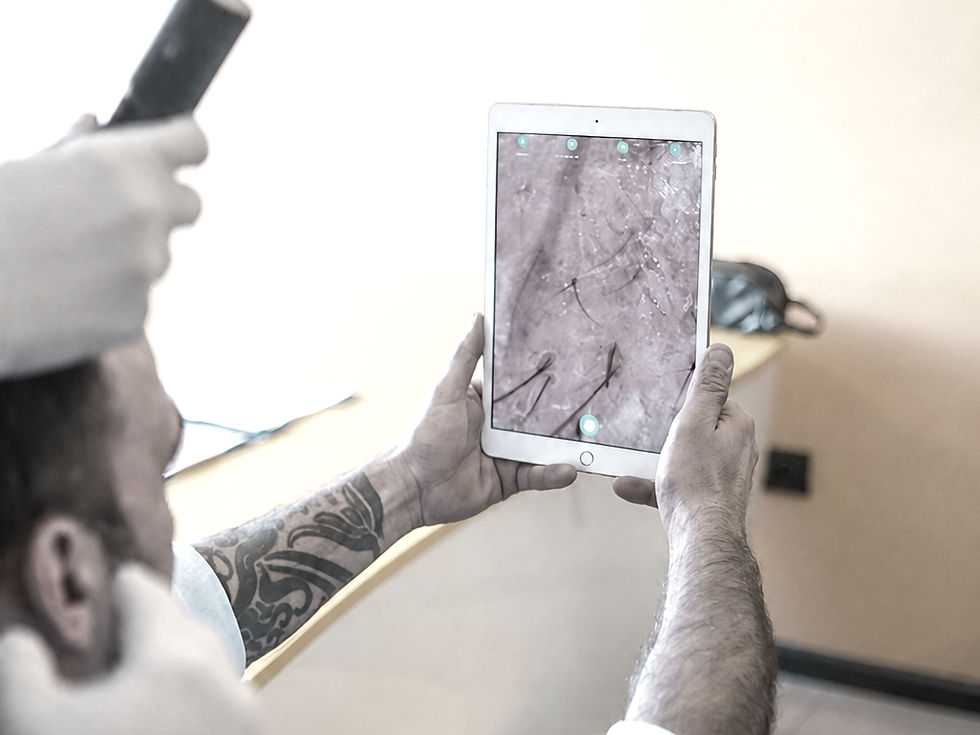
When patients envision "hair transplant technology," they naturally picture the surgical instruments utilized directly on the scalp. However, one of the most critical pieces of technology in a bespoke clinic operates entirely behind the scenes: the high-magnification stereomicroscope.
The human hairline is not a uniform structure. The anterior boundary (the very front of the hairline) consists entirely of ultra-fine, single-hair follicles. As the hairline transitions posteriorly into the mid-scalp, these soft single hairs merge into denser two-hair, three-hair, and occasionally four-hair follicular units.
If thick, multi-hair units are implanted at the leading edge of the hairline, the result will be a structurally harsh, biologically incorrect appearance. To prevent this, the extracted grafts must be meticulously audited and sorted prior to implantation.
At Eva Estetica, this ex vivo sorting process is a strict, microscopic discipline. Every single extracted graft is evaluated under high-powered stereomicroscopes by specialized clinical technicians. They delicately isolate the softest single hairs to construct a seamless transition zone and group the robust multi-hair units to build structural density behind it.
The Evolution of Diagnostics: AI-Assisted Scalp Analysis
In modern hair restoration, this rigorous physical sorting process is deeply enhanced by the integration of Artificial Intelligence (AI) and advanced trichoscopy in the diagnostic phase.
Before a surgical plan is finalized, AI-driven diagnostic systems are utilized to perform an objective, high-resolution analysis of the patient’s scalp. Rather than relying solely on visual estimation, these systems provide the clinical team with precise, quantifiable data regarding the patient's existing hair caliber, true follicular density per square centimeter, and total donor capacity.
This technology removes the guesswork from donor management. By calculating precise graft counts and mapping the topographical trajectory of hair loss, AI provides an incredibly accurate diagnostic map. However, the software does not design the hairline. It functions as a sophisticated navigational aid, providing the clinical team with the objective data required to determine the exact ratio of single to multi-hair grafts needed for the procedure.
This synergy between AI diagnostics and microscopic auditing represents the pinnacle of modern hair restoration. The AI provides the objective biological data, while the high-magnification microscope yields the precisely categorized materials. Ultimately, it is the human architect who synthesizes this technology, translating the data into a beautifully designed, undetectable result.
The Evolution of Extraction: Precision vs. Speed

Following the evolution from FUT, Follicular Unit Extraction (FUE) became the global medical standard. Today, this extraction process is primarily performed utilizing motorized micro-punches. This technology offers incredible efficiency, but its true clinical value lies entirely in how that efficiency is applied.
In modern, elite hair restoration, a motorized punch must be utilized as an instrument of absolute precision, not simply a mechanism for speed.
The physics of follicular extraction are highly delicate. When a micro-punch enters the dermis, it creates microscopic friction. If a device is operated at excessively high rotational speeds to expedite a surgery, this friction generates localized heat—known as thermal damage. This heat can compromise the fragile cellular structure of the follicle before it is even removed from the tissue. Furthermore, a rushed extraction phase significantly increases the risk of transection (the accidental severing of the hidden follicular root).
To secure maximum graft viability, advanced technology must be paired with clinical restraint. By utilizing ultra-fine punch diameters (typically ranging from 0.7mm to 0.8mm) and operating the motorized device at highly controlled, low-torque speeds, a master clinician can gently score and isolate the follicle without inducing thermal or mechanical trauma.
The motorized punch allows for a remarkably clean, minimal-impact extraction, but it is the patience, pacing, and strict biological protocols of the clinician that ultimately ensure the follicle survives the journey.
Deep Dive: Discover the precise micro-punch extraction and specialized biological handling behind our individual graft isolation in our dedicated clinical overview: FUE: The Science of Follicular Isolation
The Surgical Delivery Phase: Balancing Modern Hair Restoration Technology with Human Artistry

When discussing the implantation phase of the procedure, Sapphire FUE stands out as one of the most prominent advancements in modern hair restoration technology. To understand its true value, one must look past the marketing trends and examine its direct biological impact on the scalp.
In traditional FUE, the recipient sites (the tiny channels made in the bald area to receive the new hair) are typically created using standard steel surgical blades. While effective, standard steel creates a wider U-shaped incision and can lose microscopic sharpness over the course of a long procedure.
Sapphire blades, crafted from synthetic sapphire crystal, represent a significant step forward in surgical tissue management. Due to the extreme hardness of the crystal, these blades can be honed to a microscopic, V-shaped point that maintains a perfect, unyielding edge throughout the entire surgery.
The Physics of Tissue Respect
The clinical advantage of this modern hair restoration technology lies entirely in tissue respect:
Clean Separation: A V-shaped Sapphire blade parts the epidermal tissue cleanly, rather than tearing or forcing it open.
Vascular Protection: Because the incision is surgically precise and corresponds exactly to the diameter of the hair follicle, the surrounding vascular network (the blood supply) suffers significantly less trauma.
For the patient, this micro-geometric precision delivers the exact macroscopic outcomes expected of premium modern hair restoration: the scalp experiences less operative bleeding, post-surgical swelling is minimized, and the healing timeline is noticeably accelerated. Furthermore, because these V-shaped incisions can be mathematically distributed closer together without compromising the local blood supply, the clinician can achieve a superior degree of structural density.
However, the Sapphire blade cannot determine where an incision should be placed, nor can it dictate the natural angulation required for a seamless result. It remains a brilliant instrument of tissue preservation, but it requires the spatial awareness of a clinical architect to truly transform it into an instrument of aesthetic design.
Deep Dive: Discover the precise geometry and specialized instrumentation behind our high-density reconstructions in our dedicated clinical overview: Sapphire FUE: The Architecture of Maximum Density
Direct Hair Implantation (DHI): The Illusion of the "Magic Pen"

The DHI (Direct Hair Implantation) method utilizes a highly specialized surgical instrument known as a Choi Implanter Pen. Unlike the Sapphire method, where incisions are created first and grafts are placed afterward, the DHI pen houses the graft inside a hollow, spring-loaded needle. The clinician depresses the plunger, simultaneously creating the incision and depositing the graft in a single, fluid motion.
Marketing campaigns frequently position DHI as a completely distinct, "new" surgery that automatically guarantees better results than FUE. Clinically, this is inaccurate. DHI is simply a highly refined delivery mechanism used during the implantation phase.
The true technological value of the Choi pen is the absolute mechanical control it affords the surgeon. It grants the clinician 360-degree rotational authority over the graft, allowing them to dictate the angle, direction, and depth of the implanted hair with pinpoint accuracy.
This makes DHI an exceptional tool for specific anatomical challenges. It is the clinically preferred method for navigating between existing native hairs to build density without causing surgical trauma to hidden roots. It is also highly effective for executing the complex, flattened angles required at the temporal peaks or mapping the intricate spiral of a crown whorl.
But the pen itself possesses no clinical judgment. If the surgeon operating the instrument lacks a profound understanding of natural hair flow and macro-geometry, they can easily implant thousands of grafts at an incorrect trajectory. A flawlessly executed DHI procedure requires a clinician who understands the subtle mathematical shifts of hair direction across the scalp. The implanter pen simply allows that clinician to execute their vision with unparalleled mechanical fidelity.
Deep Dive: Want to explore the exact instrumentation we use? Read our comprehensive clinical breakdown of the Choi Implanter Pen and its specific applications here: DHI Hair Transplant Services at Eva Estetica
Biostimulation: Cellular Recovery Post-Surgery

The integration of advanced technology does not conclude when the final graft is placed. In elite hair restoration, the post-operative recovery phase is heavily supported by biostimulatory technology designed to optimize the healing environment at a cellular level.
At Eva Estetica, we integrate Low-Level Laser Therapy (LLLT), commonly known as Red Light Therapy, into our standard post-operative care continuum. It is important to clarify that this is not a cosmetic spa treatment; it is a scientifically validated medical intervention.
When specific wavelengths of near-infrared and red light penetrate the scalp, they target the mitochondria within the dermal cells. This light energy stimulates cytochrome c oxidase, directly accelerating the production of adenosine triphosphate (ATP)—the fundamental currency of cellular energy.
This localized cellular boost achieves several critical clinical objectives:
Accelerated Angiogenesis: It encourages the rapid micro-vascular reconnection of the newly transplanted follicles to the scalp's blood supply, securing their immediate nutritional support.
Inflammation Mitigation: It drastically dampens acute post-operative inflammation and edema, allowing the micro-incisions to close cleanly and comfortably.
Shock Loss Prevention: By stabilizing the cellular metabolism of both the newly implanted hair and the surrounding native follicles, it minimizes the severity of post-operative telogen effluvium (shock loss).
By utilizing non-invasive biostimulation to refine the healing timeline, we ensure that the transition from a surgical state to an undetectable, naturally thriving result is as rapid and seamless as modern medical science allows.
Conclusion: The Master and the Instrument
We live in an era of constant technological acceleration. Diagnostic software will continue to evolve, surgical punches will become increasingly refined, and bio-preservation protocols will grow more sophisticated.
However, the foundational truth of aesthetic medicine remains entirely unchanged: A tool is only as effective as the integrity, judgment, and surgical discipline of the hand holding it.
An advanced clinical tool utilized without a deep understanding of natural facial geometry, structural proportions, and tissue limits will still produce a rigid, artificial result. Conversely, a master clinician views technology not as a marketing shortcut, but as a mechanism of supreme fidelity—a means to execute a bespoke architectural blueprint with absolute precision.
At Eva Estetica, we invest heavily in the world's finest surgical technologies. We integrate high-magnification stereomicroscopes, AI-assisted scalp diagnostics, Sapphire crystal blades, and Choi implanter pens because they allow our clinical team to execute our artistic visions without compromise.
When choosing a hair restoration institute, you are not merely selecting a specific instrument or a proprietary acronym. You are selecting an architect for your face. Ensure you trust your care to a team that possesses the mastery to match the sophisticated nature of their tools.
Frequently Asked Questions: Technology in Hair Restoration
1. What role does Artificial Intelligence (AI) play in a modern hair transplant?
In elite hair restoration, AI is utilized as an advanced diagnostic and mapping tool rather than a replacement for surgical judgment. Software systems combined with high-resolution trichoscopy analyze the scalp with absolute objectivity, providing precise data on hair diameter, follicular density per square centimeter, and total donor capacity. This allows the surgical team to mathematically plan the procedure and protect the finite donor zone.
2. Why is microscopic graft sorting essential for a natural hairline?
The human hairline naturally transitions from ultra-fine single-hair follicles at the front to dense multi-hair units further back. High-magnification stereomicroscopes allow clinical technicians to audit, categorize, and isolate these single-hair units with extreme precision. Without this technology, multi-hair units can easily be misplaced at the leading edge, resulting in an unnaturally harsh or artificial appearance.
3. What is the actual medical benefit of a Sapphire FUE blade over traditional steel?
The primary benefit is tissue preservation. Synthetic sapphire crystal can be honed into a microscopic, V-shaped point that retains its edge throughout the surgery, whereas steel blades create a wider U-shaped incision and dull over time. The geometric precision of sapphire parts the scalp tissue cleanly, resulting in less trauma to the surrounding blood vessels, reduced bleeding, minimal post-operative swelling, and accelerated healing.
4. How does Choi Implanter Pen technology work in a DHI procedure?
A Choi Implanter Pen combines channel creation and graft insertion into a single, simultaneous movement. The extracted follicle is loaded into a hollow needle at the tip of the pen; the clinician then guides the needle into the scalp and depresses a plunger to deposit the graft. This technology grants the surgeon 360-degree rotational control over the exact angle, depth, and trajectory of the hair, making it highly effective for refined or unshaven restoration.
5. Does motorized FUE extraction cause damage to the donor hair follicles?
Motorized micro-punches are highly advanced instruments, but their safety depends entirely on operational protocol. If run at excessive rotational speeds, the micro-punch creates friction that generates localized thermal (heat) damage, which can compromise graft survival. When utilized correctly at low-torque, controlled speeds with ultra-fine diameters (0.7mm to 0.8mm), the technology achieves a highly precise extraction without structural or thermal trauma.
6. Why did the hair restoration industry evolve away from FUT (strip surgery)?
The transition from FUT to FUE represents a scientific evolution toward less invasive tissue management. FUT required the surgical removal of a continuous strip of the scalp, leaving a permanent linear scar and requiring a prolonged recovery. FUE technology allowed individual follicular units to be harvested one by one using micro-punches, achieving excellent density goals while eliminating linear scarring and significantly reducing patient downtime.
7. What are the benefits of Red Light Therapy (LLLT) after a hair transplant?
Low-Level Laser Therapy (LLLT) is a biostimulatory medical intervention used during post-operative recovery. Specific wavelengths of light penetrate the dermal layers to stimulate cellular mitochondria, increasing the production of adenosine triphosphate (ATP). This boost in cellular energy accelerates tissue repair, reduces acute localized inflammation, encourages new blood vessels to connect to the implanted grafts, and minimizes post-surgical shock loss.
8. Can automated or robotic systems design a natural hairline?
No. While automated systems can gather data and track scalp topography, they lack aesthetic judgment and spatial awareness. Designing a natural hairline requires a profound understanding of facial proportions, the facial thirds, and the subtle variations of age-appropriate symmetry. Technology acts as a navigational aid, but the definitive design remains an art form that requires human architectural sight.
9. Does advanced surgical technology inherently guarantee a higher graft survival rate?
No. A surgical tool does not dictate survival; the strict protocols and biological handling of the clinical team do. Excellent graft survival—which routinely exceeds 95% in disciplined practices—is determined by precise extraction, appropriate ex vivo hydration in chilled nutrient solutions, and gentle handling. Technology provides the precision, but surgical discipline preserves the biology of the graft.
10. How does modern technology affect the cost of a hair transplant?
Advanced surgical technologies—such as single-use sapphire crystal blades, specialized Choi implanter pens, high-magnification stereomicroscopes, and AI diagnostic software—require significant clinical investment and extended, highly coordinated operating times. While these innovations increase the baseline cost of the procedure compared to traditional methods, they provide the essential precision needed to secure maximum graft viability and an undetectable result.


Comments