What Makes a Hair Transplant Result Look Undetectable?

Updated: May 16

The most successful hair transplants are often the ones nobody notices.
Not because they make no difference, but because the difference they create feels natural enough to pass without question. The face looks more balanced. The forehead feels framed again. Expression appears stronger, calmer, or more complete. Yet the eye does not stop and identify the procedure. It accepts the result as though it belongs there.
This is what many patients really mean when they say they want a natural outcome. They do not only want more hair. They want hair that does not look transplanted. They want a result that appears believable in daylight, in movement, in conversation, and over time. They want restoration without announcement.
But this kind of undetectable result is not an accident. It is not produced by technique labels alone, nor by graft numbers, nor by density in isolation. It is created by a series of quieter decisions — decisions that are often invisible to the patient before the procedure, yet decisive in the final outcome.
At Eva Estetica, we believe the undetectable result is usually the sign of a well-planned one. The best work is rarely loud. It does not rely on visual force or obvious transformation language. It relies on proportion, restraint, donor stewardship, and a design subtle enough that the procedure disappears into the person.
This is why the quiet signs matter.
A well-planned transplant does not ask to be admired as surgery It asks only to be accepted as natural.
Table of Contents: The Quiet Signs of a Natural Result
[The Nuance of Micro-Irregularity and Single-Hair Placement]
[Direction and Angulation Are Invisible Until They Are Wrong]
[A Natural Hair Transplant Result Must Protect the Donor Area Too]
[Age-Appropriateness Is One of the Most Powerful Signs of Good Planning]
[Undetectable Results Usually Reflect Restraint at Every Stage]
Undetectable Does Not Mean Minimal

Patients sometimes misunderstand the idea of an undetectable result. They imagine it must mean a modest or unambitious one something too soft to create meaningful change.
In reality, the opposite is often true.
An undetectable transplant can transform the face significantly. It can restore a receded hairline, strengthen a weakened frontal frame, and change the way the person is perceived. The difference may be obvious in effect while remaining quiet in execution. That is the distinction.
What makes a result detectable is not usually the fact that change occurred. It is the way that change is designed. If the line is too hard, the density too abrupt, the temples too closed, or the donor too visibly affected, the procedure begins to announce itself. The viewer does not simply see the person looking better. The viewer sees the intervention.
A well-planned transplant avoids that. It produces improvement without creating visual tension. The person appears restored rather than altered. The result does not compete with the face. It settles into it.
This is why undetectable should not be confused with timid It is not the absence of effect It is the absence of visible strain.
The Hairline Is the First Quiet Sign

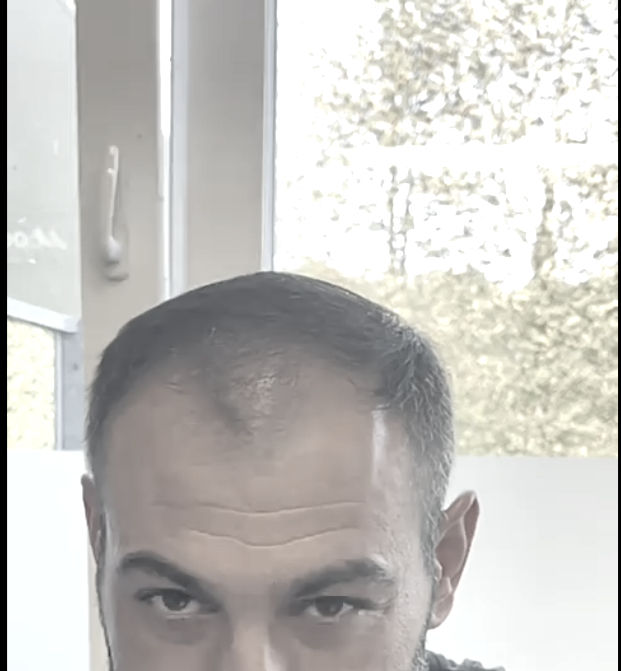
If a transplant is going to look undetectable, the first sign is almost always the hairline.
The hairline is where restoration becomes either believable or exposed. It frames the face, shapes expression, and determines whether the eye moves naturally through the upper face or stops at the procedure itself. A hard, low, overly dense frontal border may look “strong” in a cropped image, but in life it often becomes the most obvious signal that work has been done.
A natural hairline behaves differently. It does not appear as a wall. It emerges softly. The leading edge carries finer single hair grafts. Small irregularities are preserved. Density gathers gradually behind the front rather than pressing directly into it. This creates a transition the eye accepts as native growth rather than constructed density.
This subtlety is one of the quiet signs of good planning.
The patient may not consciously know why one hairline looks believable and another looks artificial, but the eye does know.
It recognises softness. It recognises variation. It recognises age appropriateness. And it notices when those things are missing.
An undetectable result therefore does not begin with maximum density at the front. It begins with the discipline not to overstate the front at all.
A hairline should not look drawn It should look found.
(Learn more about Hairline Design)
The Nuance of Micro-Irregularity and Single-Hair Placement


When a hairline is designed with rigid symmetry or a harsh, unbroken border, the eye senses that something is artificial, even if it cannot immediately explain why. In nature, a hairline is never a perfectly straight line. It is a gentle transition.
An undetectable result does not begin as a solid wall of hair; it emerges softly through a delicate zone of transparency. Creating this effect relies on a subtle but essential design principle known as micro-irregularity.
To ensure the restoration settles quietly into the face, the procedure must respect the natural mechanics of how hair actually grows. At Eva Estetica, we focus on three quiet details at the leading edge:
The Foundation of Single Hairs: The very first few millimeters of a natural hairline are composed almost entirely of fine, single-hair follicles. If thicker two- or three-hair grafts are placed at this leading edge, the result feels heavy and unnatural. A believable transplant identifies and reserves these delicate single hairs exclusively for the absolute front.
An Organic, Staggered Edge: Native hair does not grow in perfect rows. It emerges in a slightly irregular, staggered rhythm—some hairs sitting a fraction of a millimeter forward, others falling gently back. Recreating this organic variation is what allows the eye to accept the new hairline as native rather than constructed.
A Gradual Shift in Density: True visual weight is only added behind this soft frontier. Once the transparent leading edge is established, denser grafts are gradually introduced to build structure and support. The front remains soft, while the mid-scalp provides the necessary volume.
This level of refinement requires time, patience, and a deep respect for natural anatomy. The viewer may not consciously notice the placement of a single hair or the subtle staggering of a line, but they instantly recognize the harmony it creates.
An undetectable hairline is not forced onto the scalp; it is gently guided into looking as though it has always been there.
Density Must Be Distributed, Not Displayed

Another quiet sign of a well planned hair transplant result is how density has been handled.
Patients often focus on whether a result looks full. But fullness itself can be deceptive. A transplant may appear dense and still be aesthetically weak if the density has been pushed into the wrong places. In fact, one of the most common reasons a result looks detectable is that density has been treated as a display rather than a composition.
Natural density is rarely uniform. At the hairline, it should remain lighter. Behind that, density can build more strongly, creating support and shadow without harshness. Across the frontal third, it should be distributed in a way that suits the patient’s hair calibre, pattern of loss, and facial structure. The eye should feel fullness without sensing a block of implanted volume.
This is where design matters more than numbers.
An undetectable result often has density where it is needed most, not where it can most easily show off. It understands that perceived fullness depends on transition, structure, and restraint. It also understands that too much density in the wrong place can make the transplant more visible rather than more successful.
Good planning therefore treats density almost like light in a room. It must be placed carefully. Too little, and the result feels thin. Too much, and the atmosphere becomes harsh. The right amount, in the right places, creates quiet coherence.
That is what an undetectable result depends on. (Learn more about Creating undetectable hair transplant results)
Direction and Angulation Are Invisible Until They Are Wrong

One of the clearest quiet signs of a good transplant is something many patients do not know to look for: the direction and angle of the hair.
This detail is easy to ignore because it is so subtle when it is done well. But when it is wrong, the result often becomes detectably unnatural even if the hairline and density are otherwise reasonable. Hair may stand too upright, grow against the native flow, or resist styling in ways that make the work feel strange without immediately revealing why.
Natural hair has movement. In the frontal zone it tends to move forward and slightly outward. In the temples it changes again. In the crown it follows a spiral logic. These patterns must be respected if the transplanted hair is to behave like native hair rather than like placed material.
A well-planned transplant pays close attention to this. It understands that the eye does not only judge what is visible when the patient stands still. It judges how the hair behaves when the head turns, when the line is seen in profile, when the hair falls naturally rather than being styled into compliance.
An undetectable result is therefore one that moves correctly.The hair lies naturally against the scalp It belongs to the face in motion, not only in a photograph.
Direction is one of those details that patients rarely mention when they praise a result. Yet its correctness is often part of why the result feels so convincing.
A Natural Hair Transplant Result Must Protect the Donor Area Too

A hair transplant cannot be called undetectable if the donor area reveals what the front tries to conceal.
This is one of the most overlooked signs of a well-planned result. Patients often judge naturalness only in the recipient area, but the donor zone is part of the final aesthetic whole. If the back and sides of the scalp look patchy, thinned, or visibly over-harvested, the procedure has not truly disappeared into the person. It has simply moved the evidence elsewhere.
This is why donor stewardship is not separate from naturalness. It is one of its essential conditions.
An undetectable result protects the donor as carefully as it improves the front. Extraction remains balanced. The reserve is used with discipline. The area continues to appear whole, not cosmetically weakened for the sake of a more dramatic first session. This matters not only visually, but strategically.
A donor that remains healthy also preserves flexibility for the future if further work ever becomes necessary.
The best transplant therefore improves the scalp without creating a visible cost in another zone. The patient does not simply gain a better hairline. He preserves the integrity of the whole head.
That is a much quieter and much more refined standard than “how many grafts were moved.”
Age-Appropriateness Is One of the Most Powerful Signs of Good Planning


Another quiet sign of a well-planned transplant is that the result looks right for the person’s age.
This may sound obvious, but it is where many detectable results go wrong. In trying to make the patient look younger, the design creates a line too low, too juvenile, or too closed in the temples for the maturity of the rest of the face. The result may seem impressive in isolation, yet it introduces a contradiction the eye cannot fully reconcile.
An undetectable result avoids this by respecting age-appropriateness.
It does not treat youth as the only aesthetic goal. It treats harmony as the goal. The hairline must suit the forehead, the brow, the temples, and the stage of life of the patient. It should make the patient look restored, not artificially returned to an earlier version of himself.
This is where quiet beauty becomes powerful. A result can still make the patient look fresher, stronger, and more balanced without pretending that time has left no trace. In fact, that honesty is often what makes it more persuasive.
A well-planned transplant understands that naturalness is not only a matter of softness and density. It is also a matter of whether the line belongs to the person who wears it now not only to the image of who he was years ago.
(Learn more about What Makes a Hairline Look Age Appropriate)
Undetectable Results Usually Reflect Restraint at Every Stage

If there is one thread that runs through all quiet signs of good work, it is restraint.
Restraint in where the hairline begins.
Restraint in how density gathers.
Restraint in donor use.
Restraint in graft distribution.
Restraint in how much is attempted in a single session.
Restraint in promising what the result should become.
This does not mean under-treating the patient. It means respecting the fact that the eye accepts what appears natural more readily than what appears emphatic. Loud work may impress at first glance, but quiet work is what remains believable once the first impression fades.
An undetectable transplant therefore rarely comes from a clinic obsessed with maximum intervention. It comes from a team that knows where to stop. That stopping point is part of the beauty. It prevents the line from becoming too hard, the donor from being pushed too far, and the result from turning into a demonstration of what could be done rather than what should have been done.
Restraint is often misunderstood as conservatism. In reality, it is one of the highest forms of aesthetic confidence. It allows the work to disappear into the person because it has not tried to impose itself too aggressively.
A good transplant should not only solve a problem It should know how not to create a new one. (Learn more about When to Get a Hair Transplant)
The Result Must Survive Ordinary Life

One of the final quiet signs of a well-planned transplant is that it survives ordinary life.
This is where many detectable results begin to fail. They may look persuasive in a controlled before-and-after image, with flattering angles, careful styling, and ideal lighting. But everyday life is less accommodating. Hair moves. Light changes. Faces turn. People stand at conversational distance, not under studio conditions.
An undetectable result still works there.
It still looks natural when the patient is not trying to show it. It still feels coherent under daylight, in motion, and in ordinary social settings. It does not require heavy styling to hide design weaknesses. It does not need perfect lighting to maintain its credibility. It continues to belong to the face even when nothing is helping it too much.
That is why a well-planned transplant should never be judged only by how it compares before and after in a static frame. It should be judged by whether it feels native in life.
The best work is not always the most dramatic in a photograph It is often the most stable outside one.
The Eva Estetica View
At Eva Estetica, we believe the most natural results are usually the most carefully planned ones.
A transplant becomes undetectable not through a single trick, but through the cumulative effect of many correct decisions: a hairline softened properly, density distributed intelligently, direction respected, donor reserve preserved, age-appropriateness maintained, and the entire design held within the limits of restraint.
These are the quiet signs of good work.
They are rarely the things patients ask about first, because they are less visible in language than graft numbers or technique names. Yet they are often what decide whether the result will look merely improved or truly convincing.
For us, the goal is not to produce a transplant that says “look what was done.”It is to produce one that says nothing at all, because it already feels right.
That is what naturalness looks like.That is what good planning protects.
Conclusion
A hair transplant looks undetectable when the procedure itself disappears into the person.
That happens not because no change was made, but because every important decision was made with enough judgment that the result feels native to the face, the scalp, and the years ahead. The hairline softens instead of hardens. Density supports instead of overwhelms. The donor remains intact. The line suits the age of the patient. The hair moves naturally. The result survives ordinary life.
These are the quiet signs of a well planned transplant.
Patients often search for the method that will make a result look natural.The better question is whether the planning behind the method is strong enough to make the procedure disappear.
Because in the end, what makes a hair transplant look undetectable is not mystery ıt is design, restraint, and the discipline to let the result belong.
A considered result begins with understanding the face, the donor area, and the kind of naturalness that does not need to announce itself.
Frequently Asked Questions: Achieving an Undetectable Hair Transplant
1. What is the most important factor in making a hair transplant look natural?
An undetectable result is never created by a single factor. It requires a harmony of deliberate surgical choices: a softly staggered hairline, correct hair angulation, intelligent density distribution, and the preservation of the donor area. True naturalness is about architectural proportion, not just moving the highest number of grafts.
2. Why do some hair transplants look "pluggy" or artificial?
Artificial-looking results usually happen when clinics place thick, multi-hair grafts at the very front of the hairline or design a perfectly straight, geometric border. In nature, a hairline emerges softly with single hairs in a slightly irregular pattern. If a surgeon ignores this organic micro-irregularity, the transplant will immediately look constructed.
3. What is "micro-irregularity" in hairline design?
Micro-irregularity is the deliberate, artistic staggering of fine, single hairs at the leading edge of the hairline. Nature never draws a perfectly straight line. By recreating nature's slightly chaotic, asymmetrical growth patterns, the surgeon ensures the new hairline looks entirely native and organically flawed, rather than surgically drawn.
4. Can people tell I had a hair transplant if they look closely at my scalp?
A masterfully planned transplant is designed to survive everyday life, daylight, and close conversational distance. By utilizing single-hair follicular units at the absolute front and matching the precise angle and direction of your native hair, the result becomes virtually undetectable to the naked eye once fully healed.
5. Does an undetectable result mean I have to accept a thin or low-density hairline?
No. It means density is distributed with architectural intelligence. We build a soft, transparent leading edge and place the heavier, multi-hair grafts just behind it. This creates deep structural support and the powerful illusion of maximum fullness without creating a harsh, unnatural wall of hair at the front of your face.
6. Will the donor area at the back of my head look visibly harvested?
It should never look depleted. An undetectable transplant protects the donor zone just as fiercely as it improves the frontal hairline. Through strict donor stewardship and perfectly balanced extraction, the back and sides of the scalp should retain their natural integrity and show no visible signs of surgery.
7. How soon after the procedure will the transplant look completely natural?
While hair begins to grow visibly around 3 to 4 months, true naturalness takes time. It typically takes 12 to 18 months for the transplanted hair to fully mature, soften in texture, and perfectly match the caliber and behavior of your native hair. Once it reaches this stage, it settles quietly into the face.


Comments