When Hair Transplant Design Matters More Than Density

Updated: May 18

In hair restoration, density is often treated as the final measure of success.
Patients ask how many grafts will be used. They compare results by how full the frontal zone appears.
They look at before-and-after images and instinctively reward the case that seems strongest, lowest, or most dramatic.
In a field where visible change carries such emotional weight, this reaction is understandable. Hair loss affects identity, youthfulness, and confidence. It is natural to want more hair, and natural to imagine that more density must therefore mean a better result.
But in aesthetic terms, density alone rarely decides whether a transplant is beautiful.
There are results with impressive graft counts that still feel artificial. There are hairlines that appear dense in photographs but too hard, too abrupt, or too visibly treated in life. And there are quieter results sometimes even softer results that transform the face far more convincingly because they have been designed properly.
This is where the difference between coverage and restoration becomes clear.
At Eva Estetica, we believe density matters, but only once it has been placed inside the right design. A good hair transplant is not simply the addition of more hair. It is the arrangement of hair in a way that feels proportionate, native, and believable over time. That requires judgment before numbers. It requires architecture before volume. It requires understanding what the face needs, what the donor can support, and what kind of result will still look natural years later.
This is why design matters more than density.
Not because density is unimportant, but because density without design can easily become noise. Design, by contrast, gives density meaning. It decides where the eye should feel softness, where it should feel support, and where a result should remain understated in order to look true.
The patient may come asking for fullness. What he usually needs is coherence.
Table of Contents: Understanding Hair Transplant Design
Why Density Is So Easy to Misunderstand

Density is attractive because it feels measurable. It can be counted, estimated, compared, and marketed. It gives both patients and clinics a language of apparent certainty: more grafts, more fullness, more change.
But density as a visual idea is often confused with density as an aesthetic achievement.
A transplant may place a large number of grafts into a treated area and still fail to look natural. The reason is simple. The eye does not judge a result by quantity alone. It judges the relationships between things: the relationship between the hairline and the forehead, between the frontal edge and the denser zone behind it, between the restored area and the remaining native hair, between the recipient area and the donor that made it possible.
If those relationships are weak, density becomes blunt. It no longer supports the face; it interrupts it.
This is why some results feel dense but not elegant. The visual force is present, yet the harmony is missing. The line may be too low. The front may be too heavy. The transition may be too abrupt. The donor may have been pushed too far in order to create a more dramatic first impression. What remains is not refinement, but insistence.
By contrast, a well-designed result can appear natural even at a more moderate density because the distribution is intelligent. The softness is where it should be. The structure is where it is needed. The face is framed rather than overpowered. In such cases, the patient may still receive meaningful fullness, but what persuades the eye is not only how much hair has been placed. It is how correctly that hair has been made to belong.
The difference is subtle, but decisive.
A Hair Transplant Design Is Not a Wall


The first place where design matters more than density is the hairline.
Patients often imagine that a stronger hairline means a better one. They ask for lower placement, fuller density, and a more decisive frontal line. Yet the hairline is exactly where too much density can make a transplant most visible.
Natural hairlines do not emerge as dense walls. They begin softly. They contain irregularities. They use finer single-hair grafts at the leading edge. They allow density to gather behind the front line rather than at it. This creates a transition that the eye accepts as native growth.
When density is pushed too heavily into the front, the result may look powerful at first glance, but it also risks becoming readable as work. The line gains impact and loses ease. It becomes too uniform, too compressed, too sure of itself.
A natural hairline should not feel drawn It should feel discovered.
This is where design becomes primary. The question is not how much density can be placed at the front, but what kind of front will allow the face to look natural.
Sometimes that means softness where the patient expected more force. Sometimes it means slightly more maturity in the line than he first imagined. Sometimes it means resisting the temptation to create a dramatic edge simply because dramatic edges photograph well.
The better result is often the one where the density has been held back just enough for the line to remain believable. That restraint is not underperformance. It is one of the main reasons the result works.
(Deep Dive into Long-Term Architecture: Discover why recreating the soft, natural progression of a mature hairline is essential for the decades ahead in The Lifetime Blueprint: Designing Long-Term Hair Transplant Results)
Proportion Gives Density Its Meaning

A hair transplant design is never judged only in the recipient area. It is judged in the face.
That is why proportion matters more than raw fullness.
A dense result can still look wrong if the forehead has been shortened too aggressively, if the temples have been closed too heavily, or if the restored frame no longer belongs to the age or structure of the patient. In such cases, the problem is not lack of density. It is that density has been placed in the wrong aesthetic context.
A well-designed result respects facial proportion first. It understands how the hairline relates to the brow, how the temples support expression, how the frontal frame changes the balance of the upper third of the face, and how the line should feel not only now, but as the rest of the features continue to mature.
This is why two patients can receive similar graft counts and produce entirely different aesthetic outcomes. The decisive factor is not the number itself. It is the judgment behind its placement.
Design asks:
what height suits this face?
what temple shape feels natural here?
where should density soften?
where should it accumulate?
what can this patient wear convincingly for years, not only months?
Without those questions, density remains a technical event.With them, it becomes an aesthetic decision.
The face does not reward volume alone. It rewards proportion. And proportion is what allows density to stop looking like intervention and start looking like identity.
(Deep Dive into Diagnostic Precision: Learn how our master teams assess facial geometry and anatomical ratios before ever discussing graft counts in The Philosophy of a Bespoke Hair Transplant Consultation)
Naturalness Depends on Transition, Not Force


Many patients think of hair restoration in simple binaries: before and after, thin and full, empty and dense. But beauty in transplantation is almost always created in the middle ground in transitions.
The frontal edge transitions into the denser zone behind it. The transplanted area transitions into existing native hair. The restored frame transitions into the temples and side profile. Even the donor must transition visually into the surrounding scalp without looking visibly depleted.
Results that focus too heavily on density often become weaker at these transition points.
They may create a strong photograph, but the eye feels the abruptness. The change is too hard where it should be gradual. The front edge is too heavy where it should be feathered. The line arrives too quickly, without the subtlety that nature ordinarily provides.
A well-designed transplant pays close attention to these thresholds. It uses density not as a uniform blanket, but as a calibrated progression. It understands where softness should remain, where visual weight should gather, and where leaving a little less can actually make the overall result look more complete.
This is one of the quiet truths of good work: the most convincing result is often not the one with the most force, but the one with the best transitions.
Naturalness is rarely built through maximum intervention It is built through control.
(Learn more about What Makes a Hairline Look Age Appropriate?)
Donor Stewardship Is Part of Design

Another reason design matters more than density is that density always comes at a biological cost.
The donor area is finite. Every graft used in pursuit of greater fullness is taken from a reserve that must also serve the future. If density becomes the main objective without sufficient design discipline, the result may look stronger today but weaken the long-term picture tomorrow.
This is especially important in younger patients or in patterns of loss that may continue to evolve. A clinic driven primarily by the visual appeal of a dense first session may over-commit donor reserve, leaving fewer options later and sometimes making the donor itself look cosmetically compromised.
That is not refinement It is short-term emphasis.
A design-led approach protects the donor because it understands that the scalp must be treated as a whole. The recipient area should improve without the donor area appearing sacrificed in exchange. Future flexibility should remain intact where possible. And the treatment plan should respect not only what the patient wants to see now, but what the scalp may still require later.
This is why donor stewardship is not separate from aesthetic judgment. It is part of it.
A result that looks dense from the front but has spent the donor carelessly is not truly well designed. A result that uses density more selectively, preserves the donor, and maintains long-term coherence may appear less aggressive in the first photograph, but it is often the more beautiful and intelligent outcome.
Design sees the whole field.Density sees only the treated zone.
(Essential Reading on Biological Stewardship: Learn why chasing density without strict architectural discipline can bankrupt your future in Why Donor Area Preservation Matters More Than Patients Realise)
Why Some Softer Results Are Actually More Beautiful
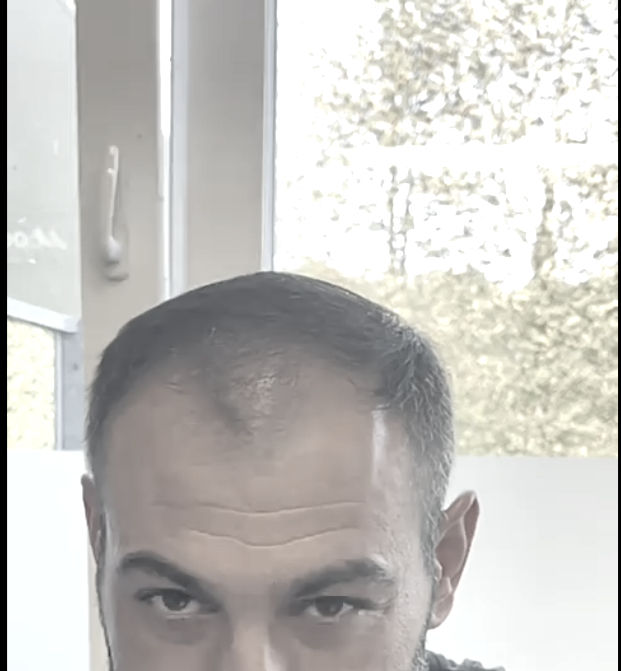

Patients are often surprised to learn that some of the most beautiful hair transplant results are not the densest ones.
This does not mean they are weak. It means they are composed.
A softer leading edge, an age-appropriate line, a slightly more open temple, a more measured use of grafts through the frontal third these decisions can create a result that feels much more natural than a heavier, lower, more aggressive alternative. The visual effect may be less instantly dramatic, but the harmony is greater. The face is flattered, not overwritten.
This is especially true in mature patients, in cases of finer hair calibre, and in patients whose existing native hair still plays an important role in how the result will be read. What appears “less” in one isolated sense can become “more” in the only sense that finally matters: the result looks true.
A softer result also often ages better. It remains credible as the rest of the scalp evolves. It does not force the patient to carry a hairline that eventually looks disconnected from his age or surrounding pattern of loss. It allows the transplant to settle into life rather than stand apart from it.
The problem is that many patients are not shown how to read beauty this way. They are shown numbers,and dramatic contrasts. They are taught to admire the loudest result rather than the most coherent one.
A refined Team should correct that vision.
Design Is What Turns Technique into Art

Technique is essential. Precision in extraction matters. Precision in implantation matters. Angulation, direction, recipient-site planning, and graft handling all matter.
But technique alone does not create beauty.
Technique can place density Design decides what density should become.
This is why two teams using the same method can produce such different outcomes. One may create a result that appears technically competent yet visually harsh. Another may create something quieter, more proportionate, more persuasive. The difference is rarely the tool in isolation. It is the quality of the design decisions governing its use.
This is also why method labels are often overvalued by patients. FUE, DHI, Sapphire FUE these are important differences, but they do not resolve the deeper aesthetic question on their own. A beautifully designed result can emerge through different technical routes.
A poorly designed result can wear a sophisticated technical label and still look wrong.
At Eva Estetica, this is why we say technique follows design. The method is chosen according to what the design requires, not the other way around. The face, the donor, the age of the patient, the likely future of loss, and the quality of native hair all shape how the technique should be used.
Without design, density is only accumulation.With design, it becomes restoration.
The Most Convincing Results Are Not Obsessed with Proving Themselves

One of the clearest signs that design matters more than density is this: the most successful hair transplants rarely feel the need to announce themselves.
They do not rely on an aggressively low hairline, an unnaturally sharp fronto-temporal angle, or a dense wall of grafts created only for immediate visual impact. Instead, they respect facial proportions and the natural behavior of hair growth. They simply look correct.
The transplanted grafts settle into the native facial structure through careful angulation and subtle directional shifts that allow light to pass and reflect naturally. Because of this, the result holds up not only in a controlled before-and-after photograph, but also in ordinary daily lighting, where small details become much more visible.
This kind of visual quietness is not accidental. It reflects disciplined surgical planning and a clear understanding that restoration should prioritize facial harmony, not spectacle. The goal is not to overwhelm the recipient area with maximum grafts, but to create a result in which micro-irregularity, transition, and proportion work together naturally.
The patient still gains restored coverage, a stronger facial frame, and the confidence that comes with looking like themselves again. But the most refined outcome is one where the observer notices the person first, not the procedure.
That is the real achievement.
The Eva Estetica View
At Eva Estetica, we do not dismiss density. We simply refuse to treat it as the highest value in hair restoration.
A good result is not measured only by how much hair is visible after treatment. It is measured by how naturally that hair belongs in the face, in the donor logic, in the transitions, and in the years ahead.
This is why our planning begins with design. We study the problem before selecting the tool. We consider hairline architecture, age-appropriateness, donor stewardship, structural density, and the long-term evolution of the scalp before discussing how much work should be done and where.
The objective is not to give density more importance than it deserves It is to put density in its proper place.
Used well, density supports beauty.Used badly, it can easily undermine it.
Design is what protects the difference.
Conclusion
When evaluating your options for hair restoration, it is easy to become caught up in the numerical race for grafts. However, a responsible medical team must focus not only on what you wish to add, but on how that addition will harmonize with your face for the rest of your life.
This is exactly why design matters more than density. It influences not only the fullness we achieve today, but how seamlessly natural the scalp remains, how the hairline matures alongside your facial features, and what biological donor options remain safely protected for your future.
A beautiful transplant does not simply move hair from one place to another to create a wall of density. It executes this biological transfer with profound judgment—ensuring that nothing finite is wasted, nothing essential is weakened, and no immediate visual improvement is purchased at the hidden cost of long-term artificiality.
In the precise discipline of hair restoration, beauty depends just as much on what is carefully restrained as it does on what is boldly restored. Your most enduring, authentic result begins with a considered blueprint—one that understands your face, respects your donor area, and designs strictly for the decades ahead.
Frequently Asked Questions: Understanding the Density
1. Why does my hair transplant look unnatural even though it is dense?
An unnatural appearance is rarely due to a lack of hair; it is usually a failure of design. If multi-hair grafts are placed at the very front of the hairline, if the hairline is drawn too straight and low, or if the hair is implanted at the wrong angle, the result will look artificial, dense "pluggy" wall rather than a natural transition.
2. How many grafts do I need for maximum density?
Maximum density is a misleading concept. Visual density is achieved through the precise angulation and overlapping of hairs, not just high graft numbers. Packing too many grafts too closely together can actually compromise blood flow and lower survival rates. A master surgeon focuses on visual coverage using the optimal, safe number of grafts.
3. What makes a transplanted hairline look natural?
A natural hairline is characterized by macro and micro-irregularities. It is never a laser-straight line. It features soft temporal recessions, a feathered leading edge built exclusively with single-hair follicular units, and a gradual increase in density as it moves back toward the mid-scalp.
4. Can a hairline be placed too low?
Yes. Placing a hairline too low is a common error known as a "juvenile hairline" design. As the human face ages, facial fat pads diminish and bone structure shifts. A low, flat hairline on a mature face creates immediate visual friction and looks distinctly like a wig. We prioritize age-appropriate, sophisticated placement.
5. How does the angle of the hair affect the transplant result?
Angulation is critical. Native hair exits the scalp at an acute angle, pointing forward and naturally layering over the hair in front of it. If a surgeon implants grafts straight up (perpendicular to the scalp), light easily penetrates to the skin, making the transplant look thin and unnatural regardless of how many grafts were used.
6. Why is transition important in a hair transplant?
Natural hair growth relies on soft transitions, not hard borders. The hairline must transition softly into the dense mid-scalp, and the transplanted hair must transition seamlessly into your native hair. Abrupt changes in density immediately signal to the human eye that a surgical intervention has taken place.
7. Does chasing high density ruin the donor area?
It frequently does. The donor area at the back of the head is a finite reserve. If a clinic extracts 5,000 grafts in a single day simply to create an overly dense frontal zone, they risk causing severe "over-harvesting." This leaves the back of your head looking moth-eaten and transparent, permanently damaging your overall aesthetic.
8. Is it possible to have a soft, feathered hairline with FUE?
Absolutely. The Follicular Unit Extraction (FUE) method allows the surgical team to selectively harvest single-hair grafts specifically for the hairline, and multi-hair grafts for the mid-scalp. It is the artistic selection and placement of these specific grafts that creates the soft, feathered edge.
9. Why do two patients with the same graft count look different?
Because graft count is only a raw material. The final visual impact depends entirely on the patient's native hair caliber (thickness), the contrast between their hair and skin color, and—most importantly—the surgeon's architectural design and angulation of those grafts.
10. Can I fix an overly dense, unnatural hair transplant?
Yes, but corrective surgery is highly complex. It often involves removing the incorrectly placed multi-hair grafts from the frontal hairline, re-implanting them further back, and creating a new, softer leading edge with single-hair grafts. This highlights why getting the architectural design right during the first surgery is paramount.


Comments