Hair Restoration Beyond the Procedure Planning for Years of Confidence Long-Term Hair Transplant Results

Updated: May 21

When you begin researching hair restoration, you are almost immediately conditioned to focus on the immediate horizon of the procedure itself. Your initial inquiries and remote consultations can easily devolve into a transactional negotiation of raw numbers: How many grafts can you extract for me? How low can you draw my new hairline? How quickly can I fly home and recover?
While these are entirely valid practical questions, they represent a short-sighted approach to what is fundamentally a lifelong medical and anatomical milestone. It is vital to understand that a hair transplant is not a temporary haircut or a style you can easily change if your tastes evolve; it is a permanent, irreversible redistribution of living, biological tissue across your scalp. The design decisions, extraction patterns, and implantation angles executed in the operating room today will permanently dictate how you look, how you feel, and how your facial features harmonize twenty or thirty years from now.
Consider the biological reality: if you choose an aggressively low, dense, and flat hairline in your late twenties or thirties, you must ask yourself how that exact same design will look when your face naturally matures. As you age, your underlying bone structure settles, skin elasticity shifts, and facial volume naturally redistributes. A juvenile hairline on a mature face creates an immediate visual conflict that can inadvertently signal surgical intervention.
True clinical etiquette is never defined by how many thousands of grafts can be packed into your scalp in a single, rushed day. Instead, it is defined by medical foresight. It lives in the subtle, highly specialized details: the meticulous microscopic angulation of each individual follicle to match your native growth vectors, the strategic restraint that protects your donor zone from permanent depletion, and the ethical preservation of your future biological options. True longevity always begins with a comprehensive strategy.
Table of Contents
The Illusion of the "Mega-Session": Why More is Not Always Better
The Mathematics of Aging: Designing the Age-Appropriate Hairline
The Biological Truth: DHT and Protecting the Native Ecosystem
The Continuum of Care: Navigating the Biological Cycles of Growth
Restraint as Refinement: When Staging Guarantees Long-Term Hair Transplant Results
Choosing a Partner for the Long View: Critical Questions for the Discerning Patient
The Illusion of the "Mega-Session": Why More is Not Always Better

A pervasive myth within contemporary hair restoration is that surgical success is determined by extracting the highest number of grafts possible in a single day. Broad commercial marketing routinely champions "mega-sessions" of 5,000 to 6,000 grafts, frequently utilizing aggressive, high-speed motorized extraction tools to cover vast areas of thinning in a single sitting.
While the immediate, short-term "before and after" photographs of these sessions can appear striking on social media, the long-term biological consequences can be deeply problematic.
The human scalp possesses a finite, strictly limited supply of donor hair. The safe donor zone—located at the back and sides of the head—contains follicles that are genetically resistant to the Dihydrotestosterone (DHT) hormone responsible for androgenetic alopecia. However, this zone is not an infinite resource. A healthy donor area typically yields between 6,000 and 8,000 viable grafts available for extraction over a patient’s entire lifetime.
If a facility aggressively extracts 5,000 grafts in a single initial procedure, they have essentially depleted the vast majority of the patient's biological reserve. This leaves little to no margin for error or for the natural progression of future hair loss.
(Deep Dive: Shifting your perspective away from raw surgical volume is the foundational first step toward achieving a truly undetectable result. To unpack the comprehensive surgical philosophies, anatomical design rules, and elite clinical standards that guide a completely seamless restoration, explore our definitive master manual: The Complete Guide to Natural Hair Transplants)
Donor Stewardship: The Ethical Responsibility

At Eva Estetica, we operate under the foundational principle of Donor Stewardship. We view the donor area as a finite biological bank account, and protecting its integrity is our highest clinical responsibility.
When a patient experiences hair loss in their late twenties or thirties, it is highly probable that their remaining non-transplanted native hair will continue to thin into their forties and fifties.
[Initial Surgery: Low/Dense Line] ➔ [Years Pass: Native Hair Recedes Behind It] ➔ [Result: Isolated "Island" of Grafts]
If a surgeon exhausts the entire lifetime donor supply to create an aggressively low, dense hairline today, a profound aesthetic problem can emerge when the native hair behind that line recedes a decade later. The patient can be left with an isolated "island" of transplanted hair at the front, severe baldness directly behind it, and absolutely no remaining donor reserves to correct the visual gap.
Achieving exceptional long-term hair transplant results requires deep clinical restraint. We utilize highly refined, customized FUE extraction techniques to harvest only what is structurally necessary for your current baseline. By mapping the safe extraction zones with microscopic precision, we calculate exact density thresholds per square centimeter, helping to ensure the donor zone remains visually flawless and healthy for years to come.
(Deep Dive: Protecting your biological health means recognizing when high-volume environments cut corners at the expense of your donor zone. To learn how to spot these structural red flags before booking your procedure, read our guide: Avoiding the Pitfalls: Systemic Medical Tourism Mistakes in Hair Transplantation)
The Mathematics of Aging: Designing the Age-Appropriate Hairline

When a patient seeks hair restoration, it is entirely natural to desire the exact hairline they had at eighteen. Many patients arrive at their initial consultation with old photographs, hoping to recreate that low, perfectly flat boundary of their youth. While it is easy for a commercial clinic to simply agree to this request to secure a quick booking, a truly responsible medical team must guide the patient away from this clinical trap.
A hair transplant is not merely about replacing lost hair; it is the permanent reconstruction of your facial architecture. As we mature, our facial geometry naturally evolves. Skin texture changes, facial volume shifts, and our underlying bone structure settles into a more distinguished shape. If an aggressively low, adolescent hairline is surgically placed on a fifty-year-old face, it creates an immediate visual disconnect. Rather than looking seamlessly authentic, it appears forced and out of harmony, inadvertently drawing the observer's eye to the hairline itself.
To guarantee long-term hair transplant results, our clinical architects design for the dimension of time. We focus heavily on the fronto-temporal angle—the delicate peaks where the frontal hairline meets the temples. Closing these angles completely to create a flat, rounded, or juvenile hairline destroys natural masculine framing. Instead, we intentionally design slight, mathematically calculated recessions in these temporal peaks. We are not designing to freeze you in the past; we are designing a sophisticated, structurally sound frame that will look handsome, distinguished, and entirely native to your character at age forty, fifty, and beyond.
Restoring Proportion, Not Just Hair

o secure natural, lasting hair restoration, the surgical design must balance seamlessly with the patient's future facial proportions.
At Eva Estetica, we utilize the classical "Rule of Thirds" to thoughtfully restore the vertical harmony of the face, measuring the distances from the chin to the base of the nose, the nose to the brow, and the brow to the newly proposed hairline. True aesthetic harmony is typically achieved when these three facial tiers closely mirror one another, rather than allowing an overly low forehead to dominate the upper face.
+-----------------------------------+  <- Proposed Hairline (Trichion)
|           Upper Third             |
+-----------------------------------+  <- Brow Line (Glabella)
|           Middle Third            |
+-----------------------------------+  <- Base of Nose (Subnasale)
|           Lower Third             |
+-----------------------------------+  <- Chin (Menton)
Furthermore, true visual density is not achieved by packing thousands of multi-hair grafts into a straight row. Instead, we soften the leading edge of the hairline with fine, single-hair grafts, while strategically allocating the dense, multi-hair units into the corridor of greatest light reflection—the central forelock and the part line. This tailored arrangement yields outsized perceptual improvements in volume without needlessly wasting your finite graft supply.
(Deep Dive: A flawless hairline relies on specialized design principles far more than raw numbers. To explore how our medical board maps these natural gradients, read our central masterclass: The Philosophy of a Bespoke Hair Transplant Consultation)
The Biological Truth: DHT and Protecting the Native Ecosystem
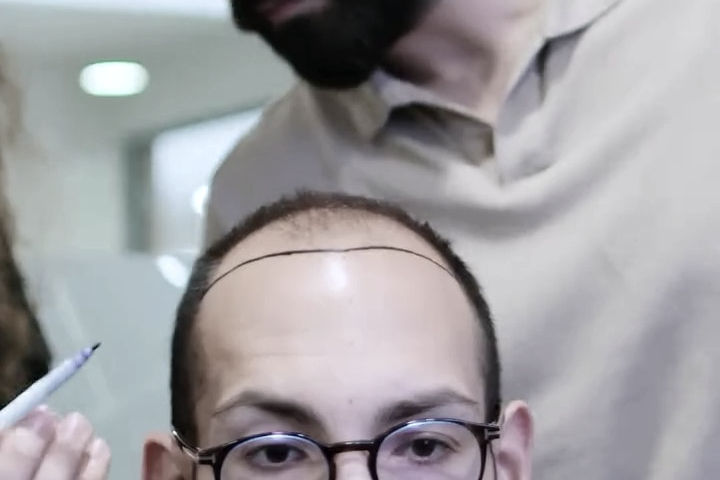
Perhaps the most pervasive misconception in the restoration industry is that a hair transplant is a permanent "cure" for hair loss. It is not. Surgery is a structural intervention; it permanently redistributes follicles that are genetically resistant to Dihydrotestosterone (DHT) into areas of baldness. However, the surgery does absolutely nothing to stop the ongoing progression of hair loss in your native, non-transplanted hair.
This biological reality introduces a significant long-term risk. If you successfully rebuild your frontal hairline but ignore the active, genetic miniaturization of the native hair directly behind it, you risk developing what clinicians call the "island effect" over the next decade. As your native hair continues to recede, you can be left with a dense, transplanted hairline at the front, followed by an unnatural gap of baldness behind it.
Surgical craft sets the stage, but how you care for your body helps that performance endure. At Eva Estetica, we view medical stabilization not as an optional addition, but as an absolute prerequisite for a successful long-term outcome. Securing your investment requires a dedicated partnership to fiercely protect the remaining biological ecosystem on your scalp. We provide you with highly bespoke, actionable guidance across three essential pillars:
Nutritional Optimization: Your hair follicles are among the most metabolically active tissues in the human body. We educate you on the critical role of highly bioavailable proteins, iron reserves (ferritin levels), and Omega-3 fatty acids. These nutrients act as the cellular fuel required for your newly vascularized roots to sustain optimal hair protein synthesis.
Stress and Cortisol Management: Chronic psychological or physical stress triggers a systemic release of cortisol. High cortisol levels can prematurely push hair follicles out of their active growth phase (anagen) and into a shedding phase (telogen), while simultaneously constricting the delicate micro-capillaries in the scalp, depriving your hair of vital oxygen.
Targeted Adjunctive Therapies: Rather than relying blindly on harsh, systemic hormonal blockers like oral Finasteride—which can carry unwanted systemic side effects for certain individuals—we champion a localized, biostimulatory approach. We advise on the strategic use of high-concentration Platelet-Rich Plasma (PRP) treatments, advanced topical protocols, and low-level Red Light Therapy to actively suppress localized scalp inflammation and maintain robust micro-circulation without disrupting your systemic equilibrium.
By actively protecting your native hair, we ensure that your transplanted results blend flawlessly and stay beautifully integrated for decades to come.
(Deep Dive: True restoration requires looking past the surgical day and treating your scalp as a living, dynamic ecosystem. To dive deeper into the metabolic science, nutritional protocols, and specific daily lifestyle habits needed to optimize your cellular recovery and maximize your growth, explore our clinical masterclass: Nutrition and Lifestyle: How to Maximize Your Hair Transplant Results)
The Continuum of Care: Navigating the Biological Cycles of Growth

A durable outcome successfully marries elite surgical craft with long-term lifestyle management. The surgery provides the structural blueprint, but your body's natural biological cycles provide the living materials to sustain and mature it. Because the first twelve months post-surgery represent a highly dynamic, delicate biological process, your journey cannot simply end when you walk out of the operating room. A dedicated continuum of care is essential to protect your investment.
When you return home, your scalp begins an intricate, month-by-month physiological transition. Understanding these hidden biological phases is critical to your peace of mind, ensuring you can navigate the recovery period with complete confidence:
Days 1 to 10: The Cellular Anchoring Phase: In the immediate days following your procedure, the newly implanted grafts rely entirely on a process called plasmatic imbibition—absorbing nutrients directly from the surrounding tissue fluid like a sponge. By day three, a critical process known as neovascularization begins, where microscopic new blood vessels sprout and connect to the base of each follicle. During this window, absolute compliance with washing protocols and protecting the scalp from friction is paramount to ensure these delicate vascular lifelines are securely established.
Weeks 2 to 12: Cellular Dormancy and the Shedding Window: As your scalp heals, the micro-trauma of the shifting blood supply signals the follicles to temporarily transition from their active growth phase (anagen) into a resting phase (telogen). This is the period where the temporary hair shafts shed. Biologically, this shedding is a positive sign that the follicle is resetting; the root remains deeply anchored, healthy, and completely safe beneath the skin.
Months 4 to 8: The Anagen Awakening: Around the fourth month, the newly vascularized roots awaken and begin synthesizing new hair proteins. This growth does not happen uniformly all at once. Hair activates in waves, meaning your initial density may look fine, soft, or slightly asymmetrical. This is a entirely normal biological progression as individual follicular cycles sync up.
Months 9 to 12: Maturation and Diameter Calibration: The final stage of your restoration is not about sprouting new hairs, but about the maturation of the hair caliber. The newly emerged shafts gradually coarsen, mature in texture, and match the exact visual vocabulary of your surrounding native hair, culminating in your final, permanent density.
Because this timeline is a year-long physiological evolution, true private medicine demands continuous clinical oversight long after you leave Istanbul. At Eva Estetica, we manage this continuum of care through structured, remote diagnostic checkpoints. We track your vascular healing, monitor your growth cycles, and refine your localized biostimulatory protocols in real time, ensuring you are supported, educated, and completely reassured through every single milestone of your biological recovery.
(Deep Dive: Navigating your recovery with absolute peace of mind requires a deep understanding of your scalp's month-by-month physiological timeline. To explore our definitive clinical manual on post-operative healing markers and see how our medical board monitors your progress across international borders, view our specialized guide: The Ultimate Roadmap to Hair Transplant Recovery)
The Reality of the "Ugly Duckling" Phase

Among the distinct milestones of your recovery, none tests your patience or psychological resolve quite like the period colloquially known as the "Ugly Duckling" phase. One of the greatest challenges to your peace of mind during this window is a lack of deep education regarding the post-operative timeline. When you look in the mirror between weeks four and twelve, you may temporarily look thinner than you did before you walked into the clinic. For an uneducated patient, this sudden regression can feel alarming—but biologically, it is a necessary part of the architectural blueprint.
To navigate this phase without anxiety, it helps to understand the two distinct physiological events occurring simultaneously on your scalp:
Transplanted Hair Shedding: Within the first two to four weeks following your procedure, the temporary, visible shafts of your newly implanted hairs will fall out. This is a entirely normal biological reset. The micro-trauma of relocation signals the follicle to cast off its old hair shaft and enter a temporary, dormant resting phase (telogen). The underlying root is completely safe, deeply anchored, and merely resting before it begins to synthesize brand-new, permanent hair.
Temporary Native Shock Loss: Occasionally, the healthy, non-transplanted native hairs directly surrounding the treatment zone will also shed. This occurs because the surrounding scalp tissue experiences temporary localized edema (swelling) and a minor disruption in micro-circulation during the healing process. Just like the transplanted grafts, these native follicles are not damaged; they are simply resting and will return alongside your new hair.
[Week 2-4: Shedding Begins] ➔ [Week 6-8: Peak "Ugly Duckling" Phase] ➔ [Month 3-4: New Growth Awakens]
Experiencing this phase can be visually frustrating, which is precisely why high-end private medicine prioritizes open communication over clinical isolation. We do not leave you to navigate this awkward aesthetic transition alone.
At Eva Estetica, we provide a transparent, day-by-day roadmap so you know exactly what to expect before it happens. We remain in consistent contact throughout these weeks, monitoring your scalp's cellular progress and guiding you through customized care protocols—such as gentle massage and localized biostimulation—to ease the tissue through dormancy. Around the three-to-four-month mark, this patience rewards you as those awakened follicles slowly begin to push through the skin, initiating the lifelong return of your natural density.
Restraint as Refinement: When Staging Guarantees Long-Term Hair Transplant Results

Restraint as Refinement: When Surgical Staging Secures the Ideal Outcome
There are instances where a patient presents with advanced hair loss (such as a Norwood 5, 6, or 7 classification) that simply cannot, and should not, be addressed in a single surgical session. In high-volume facilities, clinics may attempt to force a complete result in one day, over-harvesting the donor area or spreading the grafts too thinly across the recipient scalp, which can lead to a weak, see-through appearance.
At Eva Estetica, we view surgical staging not as a limitation, but as the ultimate measure of elite clinical responsibility. For patients requiring extensive restoration across both the front and the crown, we frequently recommend breaking the process into two distinct procedures, spaced approximately twelve months apart.
Stage | Primary Focus | Clinical Objective |
Stage 1 | Frontal Third & Mid-Scalp | Reconstruct a flawless frame for the face and re-establish the primary hairline profile. |
Stage 2 | Crown & Vertex | Performed 12 months later, addressing the crown area once the initial grafts have matured and the donor zone has fully recovered. |
A staged plan requires patience and a commitment to the long view. However, it respects the scalp’s blood supply, maximizes the overall survival rate of the delicate grafts, and ultimately produces a denser, more natural, and highly sustainable result across your lifetime.
(Deep Dive: Protecting your surgical investment involves understanding how age-appropriate design and long-term stabilization work hand-in-hand. To read more about our lifetime architectural strategies, explore our masterclass: The Lifetime Blueprint: Designing Long-Term Hair Transplant Results)
Choosing a Partner for the Long View: Critical Questions for the Discerning Patient

If you are considering hair restoration in Istanbul or beyond, it is vital to shift your perspective. You are not merely purchasing a one-day medical procedure; you are investing in an aesthetic outcome that will accompany you for the rest of your life.
When evaluating a clinical team, you should ask targeted questions that reach far beyond the day of surgery:
Donor Mapping: How exactly is my lifetime donor capacity mathematically documented, mapped, and protected?
Future Loss Strategy: What is the clinical strategy and stabilization plan if my native hair continues to recede five or ten years from now?
Graft Selection: Does the clinical team meticulously isolate single-hair grafts for the leading edge of the hairline to ensure an age-appropriate transition?
Remote Continuum of Care: How is my recovery, tissue healing, and long-term diagnostic follow-up managed once I return home to my native country?
The answers to these questions will immediately reveal whether a facility treats hair restoration as a fleeting, transactional commodity, or as a sophisticated, private medical craft.
A Final Note
Choosing to restore your hair is a deeply personal investment in your future self. It requires entrusting a medical team with the permanent framing of your face and the careful stewardship of your finite donor reserves. Rather than settling for a standardized template or a high-volume approach, seeking a bespoke, design-first philosophy ensures that your unique biology and facial architecture are fully respected.
At Eva Estetica, we measure our success by the seamless, undetectable integration of every follicle we place. By honoring the delicate balance between rigorous surgical science and nuanced architectural foresight, we help ensure your restoration matures gracefully alongside you, looking distinguished and entirely authentic at every stage of your life.
Your journey to Istanbul should culminate in a result that feels profoundly natural, structurally sound, and inherently yours. We invite you to experience the dedicated focus, unhurried pace, and tailored care of true, private medical craftsmanship.
Frequently Asked Questions: Securing Decades of Confidence
1. Why shouldn't I just opt for a "mega-session" to get full density immediately?
While a mega-session of 4,000 to 5,000 grafts sounds highly efficient, it often compromises your long-term results. Your safe donor zone is a finite biological bank account holding roughly 6,000 to 8,000 viable grafts for your entire lifetime. Exhausting almost all of it in a single, aggressive day leaves you with no safety margin if your native hair continues to recede as you age. Furthermore, packing too many grafts at once can overtax the scalp's local blood supply, leading to lower graft survival rates.
2. What exactly is the "island effect," and how do I avoid it?
The island effect occurs when a clinic builds a dense, low hairline at the front but ignores the ongoing, genetic thinning of the native hair directly behind it. Because hair loss is progressive, if the native hair continues to recede over the next decade and no stabilization plan is put in place, you can be left with an isolated "island" of transplanted hair at the front and a severe, unnatural gap of baldness behind it. Avoiding this requires ethical donor preservation and long-term medical stabilization of your native hair.
3. Why is an aggressively low, flat hairline considered a long-term risk?
4. Does a hair transplant permanently stop me from losing more hair?
No. A hair transplant is a structural relocation of hair follicles, not a biological cure for alopecia. The transplanted follicles are harvested from the safe donor zone, meaning they retain their genetic resistance to Dihydrotestosterone (DHT) and will continue to grow permanently. However, your surrounding native, non-transplanted hair remains fully susceptible to genetic thinning. Protecting your overall look requires a continuous partnership to maintain the health of your native ecosystem.
5. How do you achieve high density without wasting my limited graft supply?
True density is an architectural illusion created by how light interacts with your hair canopy, rather than raw volume alone. At Eva Estetica, we use a sophisticated technique called follicular grading. We isolate the finest single-hair grafts to create a soft, natural leading edge at the hairline. Directly behind this transition zone, we strategically concentrate robust multi-hair units into the corridor of greatest light reflection—the central forelock and your natural part line. This creates the visual appearance of maximum thickness while preserving your donor reserves.
6. What causes the transplanted hair to shed a few weeks after surgery?
This temporary shedding, often called shock loss, is a entirely normal biological reset. The micro-trauma of moving the follicles disrupts their immediate nutrient supply, signaling them to cast off their temporary visible hair shafts and enter a dormant resting phase (telogen). The underlying root remains deeply anchored, perfectly healthy, and completely safe beneath the skin. It is simply resting before it begins synthesizing new, permanent hair shafts around the three-to-four-month mark.
7. How long does the post-operative "Ugly Duckling" phase last?
The "Ugly Duckling" phase typically spans from week 4 to week 12 post-procedure. During this window, the transplanted hairs have shed, and the surrounding native hair may experience temporary shock loss due to localized tissue swelling. This means you may temporarily look thinner than you did before the procedure. By the fourth month, this phase draws to a close as the newly vascularized follicles awaken and begin to push through the skin in waves of new growth.
8. Why do you recommend breaking advanced hair loss into two staged procedures?
For patients with extensive baldness (such as Norwood 5, 6, or 7 classifications), attempting to cover the entire scalp in a single day spreads the available grafts too thin and risks over-harvesting the donor area. Staging the restoration into two separate surgeries spaced twelve months apart is the ultimate measure of clinical responsibility. The first stage focuses entirely on establishing a flawless frame for the face (the hairline and mid-scalp), while the second stage addresses the crown once the donor zone has fully recovered and healed.
9. Do I have to take oral Finasteride to maintain my long-term hair transplant results?
While systemic hormonal blockers are a common conventional recommendation, they can carry unwanted side effects for certain individuals. At Eva Estetica, we favor a highly customized, localized biostimulatory approach. We partner with you to implement targeted Platelet-Rich Plasma (PRP) therapies, advanced topical protocols, low-level Red Light Therapy, and metabolic nutritional optimization. This actively suppresses localized scalp inflammation and maintains robust micro-circulation without disrupting your systemic hormonal equilibrium.
10. How does a remote continuum of care work once I return home?
Your body’s biological growth cycle is a year-long physiological evolution. True private care cannot end the moment you leave our clinic in Istanbul. We manage your recovery through structured, remote diagnostic checkpoints over the first twelve months. You will submit periodic, high-resolution photographs, allowing our medical board to track your vascular healing, monitor your emerging growth waves, and refine your localized stabilization protocols in real time from the comfort of your home.


Comments