How Many Grafts Do I Need? A Practical Hair Transplant Planning Guide

Updated: Jun 7

During every initial consultation at Eva Estetica Istanbul, the very first question a patient asks is almost always the same: "How many grafts do I need?" It is a completely logical question. Patients want to understand the scope of their surgery, anticipate the cost, and visualize the final density. However, the hair restoration industry has unfortunately turned "graft counts" into a marketing gimmick. Commercial clinics frequently promise massive, 5,000-graft "mega-sessions" to convince patients they are getting a better deal.
In the realm of elite clinical restoration, we do not sell surgery by the graft. We practice architectural donor stewardship. Calculating your exact graft requirement is a complex mathematical equation that balances your current hair loss, your future aging process, and the finite limits of your biology.
Here is a practical, clinical guide to understanding exactly how we calculate how many grafts you truly need.
"The exact number of grafts you need for a hair transplant depends on your hair caliber, donor density, and the size of your balding area. Generally, restoring a frontal hairline requires 1,500 to 2,500 grafts, while a full restoration including the crown may require a staged approach of 4,000+ grafts over two sessions."
Table of Contents: How Many Grafts Do I Need?
The Biology of the Illusion: Why More Isn't Always Better


To understand graft counts, you must first understand the fundamental goal of a hair transplant. The objective is not to replace your original hair follicle-for-follicle. Mathematically, that is impossible—you simply do not have enough donor hair on the back of your head to achieve a 1:1 replacement on the top.
Instead, a master surgeon's goal is to create the illusion of density.
Density is achieved by manipulating light. When harsh light hits a bare scalp, it reflects, making the area look bald. By strategically angling and layering transplanted follicular units, we create a dense canopy that blocks light from reaching the scalp. Once enough light is blocked, the human eye perceives the hair as completely full.
Packing an excessive number of grafts into a small area doesn't necessarily make the hair look better; it simply depletes your finite donor supply and increases the risk of surgical complications. The true art lies in achieving maximum visual opacity using the fewest possible grafts.
Deep Dive: Want to know how we manipulate angles, light, and geometry to create a flawless result? Explore our masterclass on What Makes a Hair Transplant Result Look Undetectable.
The 3 Variables That Dictate How Many Grafts for Hair Transplant You Need

If you send a photo of your receding hairline to three different clinics, you will likely get three wildly different graft estimates. This happens because a two-dimensional photograph cannot reveal the three primary biological variables that actually dictate your requirement.
1. Hair Caliber (The Opacity Factor)
Hair caliber refers to the microscopic thickness (diameter) of your individual hair shafts. This is the single most important variable in calculating your graft count. Thicker, coarser hair physically covers more surface area and blocks more light than fine, thin hair.
A patient with thick, coarse hair might only need 2,000 grafts to achieve a completely opaque, dense hairline.
A patient with very fine, thin hair might require 3,000 grafts covering the exact same geographic area to achieve the exact same visual density.
2. Donor Density (Your Biological Bank Account)
Your donor area (the back and sides of your head) is your biological bank account. We must calculate exactly how many follicular units you naturally possess per square centimeter. If your donor density is naturally low, attempting to extract 4,000 grafts will leave the back of your head looking visibly scarred and severely thinned out (over-harvested). Your graft requirement must always be balanced against what your donor area can safely afford to give.
3. Recipient Surface Area (The Geographic Geometry)
Graft counts are dictated by the physical size of your skull. A patient with a larger head requires more grafts to cover a Norwood Stage 3 recession than a patient with a smaller skull geometry. We measure the recipient area in square centimeters to determine the exact number of grafts required to build the necessary density gradient.
Deep Dive: Unsure of how to categorize the size of your balding area? Map your exact stage using our clinical guide: The Norwood Scale Explained: What Your Hair Loss Stage Really Means.
Approximate Graft Estimations by Scalp Zone

While absolute precision requires an in-person or high-definition digital trichoscopy audit, we can provide general clinical planning ranges.
From a surgical perspective, the scalp is not a flat, uniform canvas; it is a complex, three-dimensional dome. Light hits different areas of the head at different angles, and follicular units naturally grow in entirely different directions and groupings depending on their location. Therefore, we conceptually divide the scalp into three primary anatomical zones, each requiring a fundamentally different approach to graft allocation and density.
Zone 1: The Frontal Hairline (Approx. 1,500 – 2,500 Grafts)
The frontal third is the most cosmetically significant area of the scalp because it dictates your facial framing and profile.
The Architectural Strategy: Rebuilding this zone generally requires the highest degree of density and meticulous micro-artistry. To create an undetectable, natural result, surgeons typically place ultra-fine, single-hair grafts at the very leading edge to create a soft, graduated transition.
The Opacity Factor: Immediately behind that soft edge, multiple-hair grafts (naturally occurring groupings of 2 to 4 hairs) are densely placed to block light and build visual weight. Because of the density required to achieve this opacity, Zone 1 typically consumes a significant portion of a patient's donor reserve.
Zone 2: The Mid-Scalp (Approx. 1,000 – 2,000 Grafts)
The mid-scalp acts as the "bridge" connecting your frontal hairline to your crown.
The Architectural Strategy: Unlike the hairline, the mid-scalp often still contains a variable amount of native hair that may be miniaturizing. The primary surgical goal here is often layering and volume rather than absolute density. Because hair from the frontal zone naturally cascades backward over the mid-scalp (the "shingling" effect), this zone can sometimes achieve the illusion of fullness with slightly fewer grafts per square centimeter.
Shock Loss Mitigation: If the mid-scalp is heavily populated with weak native hair, the surgeon must work with extreme precision, carefully navigating between existing follicles to minimize the risk of temporary surgical shock loss.
Zone 3: The Crown or Vertex (Approx. 1,500 – 3,000+ Grafts)
The crown is often the most graft-demanding region because of its whorl geometry and light exposure.
The Architectural Strategy: The hair on the crown naturally grows in a radiating spiral pattern. Because the hair angles outward in 360 degrees, it inherently exposes the scalp to direct, overhead light. A flat, 10-square-centimeter area on the hairline requires far fewer grafts to look visually dense than that exact same sized area on the crown.
The Medical Consideration: Because the crown can easily require 3,000+ grafts just to achieve moderate coverage, we often consider non-surgical medical therapy (like Finasteride or Minoxidil) as a highly valuable component of the overall plan. Stabilizing or thickening the crown medically can help preserve precious surgical grafts for the more cosmetically critical frontal zones.
The Complex Reality of the "Full Scalp" Restoration
These numbers represent approximate planning heuristics for treating isolated zones. However, if a patient presents with advanced hair loss (Norwood Stage 5 or 6) and requires restoration across all three zones simultaneously, the mathematics change entirely.
You cannot simply add the maximum numbers together (e.g., 2,500 + 2,000 + 3,000 = 7,500 grafts) and assume it can all be performed in a single session. The donor supply is finite, and the extraction field itself, while broad, is not limitless. While large sessions can be successfully performed in carefully selected cases, donor management, tissue handling, and the biological limits of the recipient tissue are the real limiting factors.
In these complex, full-scalp scenarios, a staged approach is often a highly reasonable and safer clinical strategy. By prioritizing the frontal half in the first surgery to immediately restore the facial frame, the scalp and donor areas are allowed to heal properly before safely addressing the crown in a separate session.
Graft Counts in Action: Real-World Clinical Scenarios
To move from mathematical theory to practical reality, it helps to visualize how these graft estimations are applied to actual patients. While every surgery at Eva Estetica is custom-designed, here is how a master surgical plan typically unfolds for common hair loss stages:
Scenario A: The Norwood 3 (Rebuilding the Frontal Frame)


The Patient Profile: A 32-year-old male with deep recession at the temples (an "M-shape") but a completely solid, healthy crown.
The Graft Requirement: 2,000 to 2,500 Grafts
The Surgical Strategy: Because the hair loss is isolated to Zone 1, the surgeon can safely extract enough grafts to achieve maximum visual density in a single session. The procedure focuses heavily on artistry: placing 300 to 400 single-hair grafts at the very front to create an undetectable transition, followed by densely packed multiple-hair grafts to rebuild the receding temporal peaks and frame the face.
Respecting the Lateral Humps: Notice the purple surgical marker in the before photo—the surgeon carefully connected the new hairline down into the patient's existing "lateral humps" (the hair on the upper sides of the head). By blending into this native boundary rather than trying to lower it aggressively, the surgeon ensured a 100% natural, undetectable transition.
The Power of Single-Hair Grafts: In the "after" photo, the leading edge of the new hairline is incredibly soft. There are no harsh lines or "pluggy" multi-hair grafts visible at the front. The surgeon meticulously placed ultra-fine, single-hair grafts at the very front boundary to create a natural, feathered aesthetic.
Scenario B: The Norwood 5 (The Advanced, Staged Restoration)


The Patient Profile: A 35-year-old male with significant frontal baldness that extends through the mid-scalp, alongside a visibly thinning crown.
The Graft Requirement: 4,500+ Grafts
The Surgical Strategy: Attempting to restore this entire area in one day would compromise both the donor area and the scalp's vascular supply.
Session 1 (Focus on the Face): The surgeon safely extracts 3,000 to 3,500 grafts to densely rebuild Zone 1 (the hairline) and create moderate, layered coverage through Zone 2 (the mid-scalp). The patient is put on medical therapy to stabilize the crown.
Session 2 (The Crown Completion): 10 to 12 months later, once the vascular network has fully healed, the patient returns for a safe, secondary extraction of 1,500 to 1,800 grafts to fill in the crown. The result is a full, dense head of hair that will last a lifetime, achieved without ever risking donor depletion.
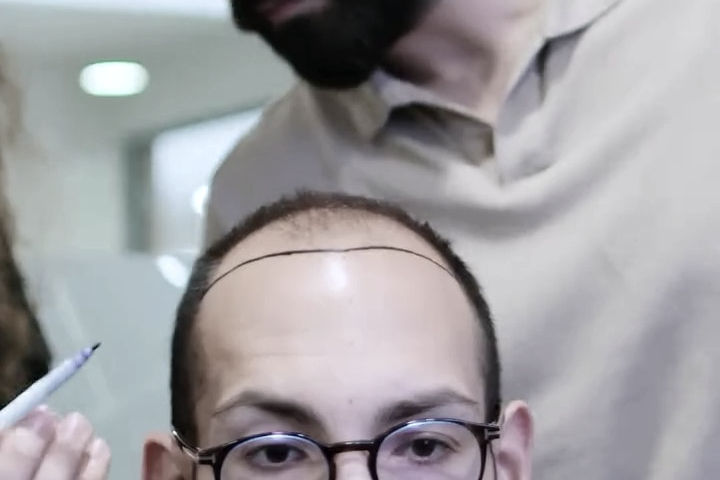
By drawing that mature, slightly recessed hairline (respecting his age and facial geometry), the surgeon saved a massive amount of grafts.
Because he is a Stage 5, those saved grafts could be packed tightly into Zone 1 and Zone 2 to create that incredible, opaque density we see in the "after" photo, while still leaving enough in his biological bank account to tackle the crown later if needed.
The Limits of Biology: How Many Grafts for Hair Transplant Can Be Done in One Session?

When facing extensive hair loss, it is completely natural to want the entire restoration completed in a single trip. Because of this high patient demand, it is common to see advertisements offering "mega-sessions"—extracting 5,000 to 6,000 grafts in a single, prolonged day.
While the idea of a one-and-done solution is incredibly appealing, at Eva Estetica, we strongly advise against pushing the scalp beyond its natural physiological limits without rigorous architectural planning.
The ultimate success of a hair transplant is not measured by how many grafts are extracted from the back of your head; it is measured by how many of those grafts actually survive, anchor, and grow in the balding areas. Attempting to move massive amounts of tissue in one day introduces significant biological and technical variables:
1. Vascular Load and Graft Competition
The scalp is a living tissue with a finite vascular supply, and every implanted follicular unit must rely on that local tissue environment to survive and revascularize. For that reason, graft survival is not determined by graft count alone, but by how carefully the recipient sites are created, how the grafts are handled, and how densely they are distributed across the scalp.
When a very large number of recipient sites are created in a limited area, the biological
demand on the tissue increases. If grafts are packed too tightly or the procedure is handled aggressively, the surrounding tissue may be subjected to more trauma, and the grafts may compete more directly for local support during healing. In well-planned cases, however, large sessions can still be performed safely when extraction, preservation, and implantation are carried out with careful tissue respect.
For that reason, the key question is not simply how many grafts are placed in a day, but whether the scalp can tolerate that density pattern without compromising healing or donor management. A responsible plan balances visual coverage with biological restraint.
2. Ex Vivo (Out-of-Body) Time and Graft Handling
Follicular units are living tissue, so the time they spend outside the body must be managed carefully. Longer procedures naturally increase the handling burden and the time some grafts remain ex vivo (outside the body). This makes preservation, continuous hydration, strict temperature control, and surgical discipline especially important. The best outcomes depend less on the clock alone and more on how gently and consistently the grafts are handled throughout the procedure. However, pushing a single session to extreme graft volumes can exponentially increase the difficulty of maintaining that rigorous standard of tissue quality control.
3. Donor Area Shock and Over-Harvesting
The trauma of a mega-session doesn't just affect the top of your head; it places massive stress on your donor zone. Extracting 5,000+ grafts in one day without meticulous stewardship significantly increases the risk of "shock loss" (temporary shedding of native hair due to surgical trauma) and permanent, visible thinning in the back of the head.
The Staged Restoration Strategy: We prioritize maximum graft survival and biological safety over sheer daily volume. If your hair loss requires a massive number of grafts for complete coverage, the safest and most medically sound approach is often to stage the restoration. By transplanting to densely rebuild the critical frontal half first, we allow your scalp's vascular network to fully heal and regenerate. Once healed, we can safely perform a second, highly successful session to restore the crown. This ensures both your donor area and your newly transplanted hair thrive for a lifetime.
Calculating Your Lifetime Donor Capacity

Hair restoration must always be planned with the future in mind. Androgenetic alopecia is progressive, which means the pattern you see today may not be the final pattern you live with over time. For that reason, a good surgical plan does not only ask how much can be restored now. It also asks how much donor reserve should be preserved for later.
The Finite Biological Bank Account
The donor area is finite. Follicular units are harvested from the more stable hair-bearing zones of the scalp, and those grafts are permanently relocated rather than regenerated in place. That is why donor management is one of the most important parts of a long-term restoration strategy.
A responsible clinic therefore avoids treating graft count as a simple target to maximize. Instead, the surgeon carefully evaluates:
How many grafts can be used safely today.
How densely they should be distributed to achieve visual coverage.
How much biological reserve must remain in case future hair loss progresses.
In patients with ongoing androgenetic alopecia, preserving donor capacity is often just as important as treating the visible recession.
Protecting Your Future Options
If too much donor hair is used too early, later restoration options may become limited. That is why a refined surgical plan does not try to solve everything in one step. It aims to create the strongest possible result today while keeping the long-term donor bank intact.
At Eva Estetica, donor stewardship is treated as part of the design itself. The goal is not only to restore hairline density, but to do so in a way that remains medically sound if the scalp continues to change in the years ahead.
The Financial Equation: Do More Grafts Mean a Higher Cost?

When patients ask how many grafts they need, they are often secretly asking another very practical question: "How much is this going to cost me?"
To understand hair transplant pricing, it helps to look at the two primary models used across the global industry: the Per-Graft Model and the Scope-Based Model.
Understanding the "Per-Graft" Pricing Model
In many Western and European clinics, surgeries are historically priced strictly "per graft." This model originated decades ago as a way to provide billing transparency. Because extracting and implanting follicles is incredibly meticulous and labor-intensive, charging per graft was a straightforward way to quantify the surgeon's time and the clinic's resources.
While this model makes logical sense, it can occasionally create a rigid dynamic in the operating room. If a patient is quoted and billed for exactly 3,000 grafts, the surgical team may feel obligated to extract that exact number to fulfill the invoice—even if, mid-surgery, the surgeon realizes perfect density could actually be achieved with only 2,500.
The Eva Estetica Approach: Scope-Based Architecture
At elite, medical-first practices like Eva Estetica, we often shift away from per-graft pricing in favor of a holistic, zone-based approach. We believe your biological needs should dictate the surgery, not a numerical quota.
The Ethical Pricing Model: Our pricing structures are based on the overall scope of the procedure, the complexity of the design, the surgical time required, and the specific zones being restored. You are investing in the final aesthetic result and the medical team's expertise, rather than buying human tissue by the unit.
Focusing on Biology, Not Quotas: This model frees the surgical team to make fluid, medically sound decisions based entirely on what is best for your scalp. If we create your recipient sites and realize you only need 2,200 grafts to achieve flawless density instead of a projected 2,500, we simply stop extracting. We protect those remaining 300 grafts, leaving them safely in your biological bank account for the future.
True clinical excellence means prioritizing your long-term donor stewardship over hitting a specific number on an invoice.
Conclusion: Transitioning from Guesswork to True Architecture
Asking "how many grafts do I need" is a natural starting point, but it should never be treated as a menu item you simply order from a clinic. Your hair is a finite, living resource.
At Eva Estetica Istanbul, we transition from generalized guesswork to exact surgical mathematics. By performing a high-definition digital trichoscopy audit, we measure your hair caliber, calculate your donor density per square centimeter, and map your precise geographic requirements.
This ensures your surgical blueprint maximizes visual density, respects the limits of your scalp's blood supply, and preserves your donor area for the rest of your life.
Frequently Asked Questions: Figuring Out Exactly How Many Grafts for Hair Transplant You Need
1. How many grafts are typically needed to restore a receding hairline?
For a receding hairline (Zones 1), approximate clinical planning ranges often fall between 1,500 and 2,500 grafts. Rebuilding this area requires high density using multiple-hair grafts immediately behind a soft leading edge of single-hair grafts. The final number depends significantly on the physical size of the recipient area, the patient's existing native density, and their desired visual outcome.
2. Is hair transplant cost always calculated "per graft"?
Historically, many clinics priced surgery purely on a per-graft basis. However, in modern hair restoration, pricing structures vary. Some elite clinics utilize a tiered or flat-fee model for restoration zones because the final graft count is highly individualized and can change during surgery based on tissue response. We focus on achieving the necessary mathematical density for a natural result rather than chasing a specific raw graft number.
3. What is the maximum number of grafts that can safely be taken from the donor area?
Your donor area has a finite lifetime biological bank account. While specific counts are individualized, most men have a potential lifetime yield of roughly 5,000 to 7,000 follicular unit grafts in total across multiple procedures (depending heavily on genetics, donor density per square centimeter, and scalp elasticity). True donor stewardship means extracting only what is mathematically necessary today to aggressively protect your reserve for potential future hair loss.
4. Do I need more grafts if my hair is very fine?
Yes. Hair caliber (thickness) is the most powerful variable in creating the "illusion of density." Thicker hair shafts physically cover more surface area and block more light from reflecting off the scalp than fine hair. A patient with very fine hair may require up to 30% to 50% more grafts than a patient with coarse, thick hair to achieve the exact same visual opacity over the same surface area.
5. If I have severe hair loss (Norwood 6 or 7), can I get all 5,000 grafts in one day?
While large single-day sessions are technically possible in some high-volume settings, we prioritize the biological limits of your biology. Creating thousands of incisions causes significant vascular stress on the scalp. To maximize the long-term survival of the grafts and protect the health of your donor area, we often advise staging advanced restorations into two separate procedures spaced roughly a year apart. This allows the scalp to heal, maximizing vascular recovery for the next zone.
6. What is the difference between a follicular unit (graft) and a hair?
This is a critical distinction. A follicular unit (graft) is a naturally occurring biological grouping of hairs that share the same oil glands, nerves, and small muscle. A single graft contains anywhere from 1 to 4 hairs. If a clinic uses 2,000 grafts with a high average hair-per-graft ratio (e.g., 2.3), you are actually receiving roughly 4,600 hairs planted on your scalp.
7. If I get a hair transplant, will I need more grafts later in life?
Androgenetic alopecia (genetic hair loss) is a progressive condition. Transplanted hair is genetically resilient and enduring, but your native hair behind the transplant will continue to be sensitive to DHT. Without medical stabilization (using therapies like Finasteride or Minoxidil), that native hair may fall out over time, potentially requiring future surgeries to maintain coverage.
8. How can I get an exact calculation of my true graft requirement?
Absolute precision cannot be achieved through submitted photographs alone. A true surgical blueprint requires a comprehensive microscopic digital trichoscopy audit. By measuring your donor density per square centimeter and hair caliber, and mapping your precise recipient surface area, we transition from generalized guesswork to exact surgical mathematics.
Academic Sources and Clinical Literature
The diagnostic frameworks, safe extraction limits, and graft estimation metrics discussed in this guide are deeply rooted in peer-reviewed dermatological literature and clinical safety standards. For further reading on follicular density and the medical limitations of hair restoration, please consult the following texts:
1. Male Pattern Baldness: Classification and Incidence Norwood OT. Southern Medical Journal (1975). The foundational medical paper that established the universal "Norwood Scale." This classification system remains the global diagnostic standard utilized by elite surgeons to categorize the progression of androgenetic alopecia and mathematically estimate the required graft counts for restoration.
View on PubMed: https://pubmed.ncbi.nlm.nih.gov/1188424/
2. Follicular Unit Extraction: Minimally Invasive Surgery for Hair Transplantation Rassman WR, Bernstein RM, et al. Dermatologic Surgery (2002). A landmark clinical study detailing the physiological mechanics of FUE and officially defining the parameters of the "Safe Donor Area." This literature explains the mathematical limits of extraction, proving why taking too many grafts risks severe donor depletion and a "moth-eaten" visual appearance.
View on PubMed: https://pubmed.ncbi.nlm.nih.gov/12174065/
3. Distribution of Human Hair in Follicular Units: A Mathematical Model for Estimating Donor Size Jimenez F, Ruifernández JM. Dermatologic Surgery (1999). This crucial dermatological research provides the mathematical and anatomical basis for calculating how many follicular units naturally occur per square centimeter. It clinically validates why graft capacities must be strictly customized to a patient’s individual donor density, rather than relying on flat commercial numbers.
View on PubMed: https://pubmed.ncbi.nlm.nih.gov/10417585/
4. Complications in Hair Transplantation: Exploring the Dangers of Overharvesting Kerure AS, Patwardhan N. Journal of Cutaneous and Aesthetic Surgery (2018). An essential clinical safety review highlighting the severe dangers of unregulated "Mega Sessions" (attempting to extract and implant 4,000 to 5,000+ grafts in a single day). The literature explicitly details how vascular overload and overly dense packing directly lead to poor graft survival and irreversible tissue necrosis.
View on PubMed Central: https://pmc.ncbi.nlm.nih.gov/articles/PMC6371733/
5. Hair Transplantation: Surgical Limitations and Graft Density (StatPearls) Zito PM, Raggio BS. StatPearls Publishing (2024). An authoritative, peer-reviewed clinical guide utilized in modern medical education. This text outlines the strict physiological limitations of graft density, explaining the biological necessity of spacing out newly implanted grafts to ensure they receive an adequate capillary blood supply for survival.
View on NCBI Bookshelf: https://www.ncbi.nlm.nih.gov/books/NBK547740/


Comments