The 5000 Graft Hair Transplant Turkey: Clinical Reality vs. Commercial Myth


If you are researching advanced hair restoration, you have undoubtedly encountered the industry's most heavily marketed term: the "Mega-Session." For patients suffering from extensive hair loss (Norwood Stages 5 through 7), the appeal of a 5,000-graft hair transplant in Turkey is incredibly strong. The promise is simple and alluring: full, maximum coverage achieved in a single day, often packaged at a heavily discounted price.
However, the human scalp is a complex, living vascular ecosystem, not an endlessly renewable canvas.
At Eva Estetica Istanbul, we believe our patients deserve absolute medical transparency. The truth is that while a 5,000-graft procedure is medically possible, it is highly conditional. It requires an elite biological profile to be executed safely. Pushing beyond your body's biological limits—or falling victim to commercial clinics selling 6,000+ graft packages—crosses the line from ambitious restoration into permanent tissue damage.
Before you invest your time, money, and finite donor hair into a massive single-day session, you must understand the clinical reality of advanced hair loss.
"A safe 5,000-graft hair transplant is strictly dictated by your biology, requiring exceptional native donor density and pristine scalp vascularity. Pushing beyond these limits in a single day severely risks tissue necrosis and permanent donor depletion. For most advanced hair loss cases, the superior medical approach is a Staged Restoration—safely executing the procedure across two sessions to ensure maximum graft survival and a flawless, lifelong result."
Table of Contents: 5000 Graft Hair Transplant in Turkey: Clinical Reality vs. Commercial Myth
The Biology of Advanced Hair Loss (Norwood 5-7)

To truly understand the profound clinical challenge of a "mega-session," you must first understand the fundamental mathematics and geography of advanced androgenetic alopecia.
When a patient progresses to Norwood Stage 5, 6, or 7, two inverse biological events happen simultaneously:
The Recipient Zone Expands: The balding area becomes vast. The native "bridge" of hair across the mid-scalp disappears, creating one continuous, bare expanse from the frontal hairline all the way back through the vertex (crown).
The Safe Donor Zone Shrinks: As hair loss progresses downward, the horseshoe-shaped ring of DHT-resistant hair at the back and sides of the head (the "safe donor zone") progressively narrows.
From a surgical perspective, the clinical team is tasked with covering a much larger geographic surface area using a significantly smaller reservoir of available hair.
The Finite Biological Bank Account
Your safe donor zone is not an endlessly renewable resource; it is a strictly finite biological bank account. Clinical data dictates that the average male possesses a total lifetime reserve of approximately 10,000 to 15,000 follicular units (grafts) in this permanent zone.
However, possessing 15,000 grafts does not mean a surgeon can extract 15,000 grafts.
The Preservation of Visual Density
To preserve the structural integrity and natural appearance of the back of your head, a master clinical architect must practice strict donor stewardship.
The human eye requires a certain density of hair to perceive the scalp as "full." If a surgeon extracts too many grafts from a concentrated area in a single day, the donor zone will lose its visual opacity, resulting in a permanently thinned-out or depleted appearance. Furthermore, over-harvesting severely depletes your donor reserve, leaving you with very few grafts to address any further hair loss as you age.
The Mathematical Reality
When we balance the need for maximum coverage on top with the absolute necessity of preserving natural density in the back, the math is clear. For an individual with an average native donor capacity, a surgeon can safely extract a maximum of 3,000 to 4,000 grafts in a single session without compromising the surrounding tissue.
Want to identify your specific hair loss pattern across the standard clinical milestones? Read our complete guide: Understanding the Norwood Scale: A Stage-by-Stage Guide to Male Pattern Baldness
Who is the Ideal Candidate for a 5000 Graft Hair Transplant?

If the safe extraction limit for an average patient is 4,000 grafts, how is a 5,000-graft mega-session even possible?
The answer is that a 5,000-graft procedure can be performed safely, but it is exclusively reserved for biological outliers. It is not a standard "one-size-fits-all" package that can simply be purchased. It is only medically appropriate when a microscopic digital trichoscopy confirms that a patient possesses a highly exceptional, above-average biological profile:
Exceptional Native Donor Density:
The patient must naturally possess a much higher concentration of hairs per square centimeter than the average male. This means their lifetime donor reserve far exceeds the typical 15,000 limit, allowing the surgeon to extract 5,000 units while still preserving complete visual density in the back of the head.
High Hair Caliber (Thickness):
Thick, coarse hair shafts provide immense visual coverage. This allows the surgeon to achieve the illusion of high density without having to dangerously over-pack the recipient incisions.
Pristine Scalp Vascularity:
The patient must have a healthy, highly vascularized scalp (excellent blood flow). Every extracted and implanted graft creates a micro-incision; the scalp must have the vascular strength to heal 5,000 incisions in a single day without compromising tissue health.
If you have fine hair, average donor density, or poor scalp circulation, attempting a 5,000-graft mega-session is biologically unsafe. For the vast majority of patients, the superior medical approach is to respect the 4,000-graft limit and plan a staged, multi-step restoration.
Want to dive deeper into the mathematics of donor capacity? Read our complete guide: How Many Grafts Do I Need? A Practical Hair Transplant Planning Guide
The Crucial Compromise: Coverage vs. Density

Even if you are a candidate for 5,000 grafts, covering a massive Norwood 6 scalp requires a fundamental architectural compromise. The laws of optical physics dictate that you cannot have both maximum coverage and maximum density across the entire head in a single session.
To understand why this compromise is necessary, you must understand how a hair transplant actually works.
The Laws of Optical Physics and the Illusion of Density
A hair transplant is never a 1:1 replacement of the hair you have lost. A patient with advanced baldness may have lost up to 40,000 individual hairs, but a surgeon is only implanting 10,000 to 12,000 hairs (roughly 4,000 to 5,000 grafts).
Because we cannot replace every single lost follicle, the master surgeon’s true objective is to create the Illusion of Density.
The human eye does not count individual hairs; it perceives light and shadow. When harsh light hits a bare scalp, it reflects back to the eye, making the area appear bald or thin. The goal of a hair transplant is to build a "canopy" of hair that absorbs or blocks that light before it can bounce off the skin.
We achieve this optical illusion through meticulous surgical architecture:
Strategic Angulation: Hair implanted at a lower, more acute angle layers over the hair behind it (known as the "shingling effect"), physically blocking more light than hair planted straight up.
Graft Layering: Placing single-hair grafts at the front for softness, and strategically stacking 3- and 4-hair grafts immediately behind them to rapidly build visual weight.
However, the illusion of density requires a certain concentration of grafts per square centimeter to successfully block the light. When dealing with the vast geographic surface area of a Norwood 6 scalp, 5,000 grafts is simply not enough to block the light everywhere at once.
The Strategic Choice
Because the laws of physics limit how much light we can block, you and your surgeon must make a critical choice:
Option A (Focus on Coverage): Spreading the 5,000 grafts across the entire balding scalp. The result is a complete covering of the head, but because the grafts are spread so far apart, light will easily penetrate the canopy and hit the scalp. The hair will appear noticeably thin, soft, and diffuse under bright lighting.
Option B (Focus on Density): Packing the 5,000 grafts tightly into the frontal third and mid-scalp. By concentrating the grafts in a smaller geographic area, we achieve complete light-blocking opacity. This creates a powerful, dense, youthful facial frame, but leaves the crown (vertex) lighter or entirely untouched.
The Eva Estetica Approach
At Eva Estetica, our medical architects prioritize Option B. Framing the face immediately restores your structural symmetry, re-establishes your profile, and provides a truly dense, undetectable result from the front.
Attempting to stretch 5,000 grafts across the entire head compromises the overall aesthetic, leaving the patient with mediocre density everywhere. By densely rebuilding the front first, we secure a flawless aesthetic foundation. The crown can then be addressed safely in a staged future procedure.
Want to explore how elite surgical planning balances total coverage with true visual depth? Read our complete guide: When Hair Transplant Design Matters More Than Density: The Optical Realities of Restoration
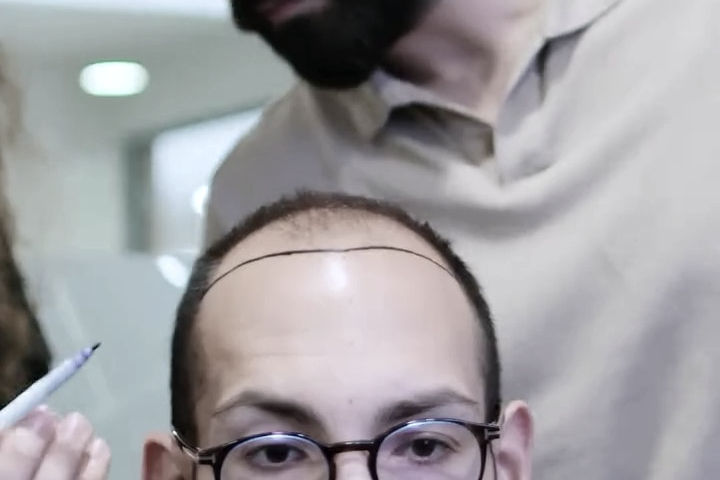
Clinical Case Study: What Does a 5,000-Graft Result Actually Look Like?


To give you a concrete idea of the coverage that is possible from a massive hair restoration, it is vital to look at how a medical team analyzes a high-graft transformation.
When mapping out an exceptional biological candidate who qualifies for roughly 5,000 grafts in a single surgical session, the analysis always comes down to balancing raw numbers with aesthetic reality.
Our Lead Medical Architect shares their clinical analysis on the challenges and outcomes associated with these high-volume mega-sessions:
"Based on our analysis of high-volume, single-session outcomes, a substantial degree of coverage can be achieved, but the final result must fundamentally appear natural. Achieving this natural integration—where the angles, direction, and hairline irregularities mimic nature perfectly—must always be the primary goal, even above raw density. One of the most common issues in extensive hair loss cases is the limited availability of donor hair.
The donor area—typically the back and sides of the scalp—often does not yield enough grafts to fully and densely cover a massive Norwood 6 or 7 bald area in one day. Attempting to extract more grafts than the donor area can safely support in a single session will lead to noticeable thinning or even permanent scarring. In specific cases, we may utilize additional donor sources, such as beard hair, to supplement the crown.
While this improves total coverage, it brings its own set of clinical challenges—particularly the need to flawlessly blend varying textures with the native scalp hair.
Achieving natural-looking density across a vast recipient area is another major challenge. 5,000 grafts is an immense number, but when distributed across the entire top of the head in one sitting, we are physically unable to implant them as densely as we would in smaller, localized areas. As a result, it can be more difficult to create the illusion of full coverage. Our architectural priority is usually to build a dense, light-blocking frontal frame while accepting a slightly softer, layered look as we move back toward the crown.
Finally, managing patient expectations is critical. Many patients understandably hope for a complete restoration of their original density, but due to strict donor limitations and physiological constraints, a 1:1 replacement is mathematically impossible. Setting realistic expectations from the outset is essential to ensure that the final outcome restores facial harmony and looks completely natural for the patient's age and structure."
The Biological Limits of a Single Session: Vascular Load and Necrosis

While 5,000 grafts sits at the absolute upper threshold of safe modern hair restoration for exceptional candidates, numbers far beyond that—often reaching 6,000, 7,000, or even 8,000 grafts—are frequently discussed in the medical tourism industry.
However, at Eva Estetica, our medical architects operate strictly within the bounds of human biology. Treating a hair transplant purely as a numbers game ignores a critical physiological reality: the scalp's vascular capacity. When a procedure attempts to force an extreme number of grafts into a single 6-to-8-hour window, the patient is exposed to a severe clinical complication known as Vascular Overload.
Understanding the Scalp's Vascular Network
To understand why surgical restraint is necessary, we must look at how a transplanted graft survives.
When a follicular unit is extracted from the donor area, it is temporarily severed from its blood supply. Once implanted into the recipient area, its survival depends entirely on its ability to rapidly connect to the surrounding capillary network to receive oxygen and nutrients (a process called angiogenesis).
The scalp possesses a robust and highly efficient blood supply, but it is not infinite. Every time a surgeon makes an incision to implant a graft, a microscopic disruption to the local blood vessels occurs.
The Mechanics of Vascular Overload
When an extreme number of grafts are packed too densely into the scalp in a single day, too many micro-incisions are made too closely together. The local capillary network becomes heavily compromised and physically cannot deliver enough oxygen to support the sudden, massive influx of thousands of new grafts. The grafts are effectively starved.
When the vascular load is overwhelmed, patients face two severe clinical consequences:
Diminished Graft Survival Rates: A successful hair transplant is not measured by how many grafts were extracted, but by how many actually grow. When 7,000 grafts are forced to compete for a limited blood supply, a significant percentage of them will fail to thrive. A patient may undergo the immense physical trauma of a massive procedure, only to experience a poor, sparse yield because the scalp could not sustain the grafts.
The Danger of Tissue Necrosis: In cases of extreme over-packing, the blood supply to the recipient area can be severed so severely that the scalp tissue itself is starved of oxygen. This leads to Tissue Necrosis—the localized death of the skin. Clinically, the affected tissue turns black and forms deep, unyielding scar tissue. Not only do the transplanted grafts fail entirely in a necrotic zone, but the resulting scar tissue permanently prevents any future hair restoration in that area.
Surgical Restraint as a Medical Standard
At Eva Estetica, we believe that true clinical mastery requires the discipline to respect the body's vascular limits. Our goal is a 100% survival rate for the grafts we transplant. By capping single sessions at biologically safe limits, we ensure that your scalp heals flawlessly, your grafts thrive, and your investment is permanently secured without ever compromising your biological safety.
The Superior Medical Alternatives for Advanced Baldness


If you have advanced hair loss but your clinical audit indicates that a single-day 5,000-graft mega-session is biologically unsafe, you are not out of options. True clinical mastery relies on strategic long-term planning. Elite surgical teams utilize advanced medical strategies to achieve comprehensive results over time without recklessly risking your vascular health or donor integrity.
1. Staged Restoration: The Multi-Phase Blueprint
Rather than subjecting the scalp to intense surgical trauma in a single day, a staged restoration divides the architecture into two distinct, controlled procedures spaced 10 to 12 months apart.
Phase One (The Framework): The surgical team focuses entirely on the most cosmetically critical region of the head. By utilizing approximately 3,000 to 3,500 grafts, the surgeon can safely rebuild the frontal hairline, re-establish the facial frame, and densely pack the mid-scalp.
The Healing Interval: Over the next year, the transplanted grafts anchor themselves, the safe donor zone recovers its laxity, and the scalp's vascular capillary network heals from the initial surgical trauma.
Phase Two (The Crown Completion): Once the tissue has safely recovered, the patient returns for a secondary session. The remaining permanent donor reserve is carefully tapped to reconstruct the crown (vertex), working outward in its natural, radiating spiral pattern.
This phased approach prevents vascular overload and supports favorable angiogenesis (the formation of new blood vessels). While maximum graft survival ultimately depends on meticulous extraction, proper hydration, temperature control, and delicate out-of-body preservation, staging a massive restoration is a critical foundational step in minimizing tissue fatigue and protecting your final yield.
2. Medical Optimization: Changing the Mathematical Equation
For an individual with a vast balding area, managing a hair transplant purely through surgery is only half of the equation. Stabilizing and preserving your existing native hair is just as critical as relocating new follicles.
The primary driver behind progressive male pattern baldness is Dihydrotestosterone (DHT), a potent hormone synthesized from testosterone via the 5-alpha reductase enzyme. In the scalp, DHT binds to genetically susceptible hair follicles, causing them to undergo a progressive degradation process known as miniaturization.
This is where advanced Medical Optimization can transform your surgical options:
The Role of Finasteride and DHT Blockers: By introducing targeted medical therapies like Finasteride or Dutasteride, we chemically inhibit the 5-alpha reductase enzyme. This lowers systemic and scalp DHT levels, which can effectively slow down or halt the miniaturization process.
Clinical Transparency and Side Effects: While DHT blockers are a cornerstone of hair loss prevention, absolute medical transparency requires acknowledging that they alter hormone profiles. Medical science and long-term studies are constantly evolving, but current literature indicates that a small minority of users (often estimated at roughly 1–3%, though rates vary by study) may experience adverse side effects. Because DHT plays an ongoing residual role in the adult male body, systemic lowering can occasionally lead to a decrease in libido or mild mood fluctuations.
Conclusion: Protect Your Biological Bank Account
Your donor area is a finite, non-renewable resource. A successful hair transplant should be an exercise in permanent architectural design, not a reckless arithmetic race to hit the highest number possible.
If you have been told your hair loss is too severe, or if you are being aggressively pressured into a massive 6,000-graft package, step back and evaluate the medical reality.
Protect your dignity, your safety, and your biological bank account.
FAQ: Planning a 5000 Graft Hair Transplant Turkey
What is a Mega Session Hair Transplant?
In the hair restoration industry, a "Mega Session" refers to a single surgical procedure where an exceptionally high number of follicular units (typically 4,000 to 5,000+ grafts) are extracted and implanted in one day. While commercial clinics market this as a time-saving convenience, true medical professionals approach mega-sessions with extreme caution, as they push the absolute biological limits of the scalp's vascular capacity and donor reserve.
Is a 5000 graft hair transplant in Turkey safe?
A 5,000-graft procedure is only safe if you possess a highly exceptional biological profile, specifically an above-average native donor density and pristine scalp blood flow. For the average patient, extracting 5,000 grafts in a single day exceeds the safe mathematical limit, risking permanent damage to the donor area and poor growth results. At Eva Estetica, we require a comprehensive microscopic trichoscopy audit to determine if your biology can safely support a session of this magnitude.
How long does a 5,000-graft hair transplant take?
The total duration of a 5,000-graft procedure depends heavily on the size of the medical team performing the operation. When a larger clinical team works simultaneously on extraction and implantation, the procedure can often be completed in about 6 to 8 hours. Alternatively, when a smaller, specialized team focuses sequentially on each individual step—such as detailed architectural design, precise angulation, and careful out-of-body graft preservation—the process naturally takes longer. In these settings, safely completing a 5,000-graft session typically requires 10 to 12 hours. Because sitting for this duration can be physically exhausting for the patient, many medical teams choose to divide a session of this magnitude across two consecutive days to ensure maximum patient comfort and optimal graft viability.
Will all 5,000 grafts grow successfully?
A successful transplant is not measured by how many grafts were extracted, but by how many survive and grow. If a clinic forces 5,000 grafts into a scalp that lacks the vascular capacity to support them, a large percentage will be starved of oxygen and fail to thrive. However, if you are a verified biological candidate and the procedure respects your tissue limits, survival rates can be exceptionally high.
What is hair transplant necrosis, and why does it happen?
Tissue necrosis is the localized death of scalp skin, resulting in blackened tissue and permanent, unyielding scarring where hair will never grow again. It is one of the most severe complications in hair restoration and is primarily caused by vascular overload. When high-volume clinics attempt to implant 6,000 or 7,000 grafts in a single day, they create too many incisions too close together, entirely severing the blood supply and starving the scalp of oxygen.
How much does a 5000 graft hair transplant cost in Turkey?
Many commercial clinics price surgeries "by the graft," creating a dangerous financial incentive to extract 5,000+ grafts simply to inflate your final bill. At elite clinics like Eva Estetica, we reject the per-graft pricing model. We charge a comprehensive architectural fee based on the surgical session and the customized design required to restore your facial frame. This ensures your medical team extracts only what is biologically safe and necessary, never compromising your health for profit.
If I am a Norwood 6, should I get 5,000 grafts all at once?
For most Norwood 6 or 7 patients, the safest and most aesthetically superior approach is a Staged Restoration. Instead of traumatizing the scalp with 5,000 grafts in one day, the surgeon flawlessly rebuilds the frontal hairline and mid-scalp in the first session (approx. 3,000 to 3,500 grafts). After 10 to 12 months of vascular healing, a second session safely addresses the crown. This multi-phase approach supports favorable blood vessel formation and completely eliminates the risk of vascular overload.
Academic Sources and Clinical Literature
The surgical philosophies, mathematical limitations, and biological metrics discussed in this guide are strictly governed by peer-reviewed dermatological literature, anatomical studies, and clinical reviews. For further reading on the science of high-volume hair restoration, donor capacity, and vascular safety, please consult the following foundational texts:
1. Follicular Unit Extraction: Minimally Invasive Surgery for Hair Transplantation
Rassman WR, Bernstein RM, et al. Dermatologic Surgery (2002).
This is the foundational clinical text that established the modern mathematics and safe parameters of Follicular Unit Extraction (FUE). It strictly defines the limits of donor zone harvesting to prevent permanent visual depletion (the "moth-eaten" appearance) and warns against over-harvesting the finite lifetime donor reserve.
View on PubMed: https://pubmed.ncbi.nlm.nih.gov/12269874/
2. The Death of the Density Debate
Marritt E. Dermatologic Surgery (1999).
A pivotal study on the optical physics of hair restoration. This paper established the clinical reality that the human eye typically cannot detect hair loss until roughly 50% of the native density is gone. This exact mathematical threshold forms the foundation for how elite surgeons plan the "illusion of density" and calculate coverage vs. density without needing a 1:1 follicle replacement ratio.
View on PubMed: https://pubmed.ncbi.nlm.nih.gov/10491049/
3. Complications in Hair-Restoration Surgery
Konior RJ. Facial Plastic Surgery Clinics of North America (2013).
A comprehensive clinical review detailing the physiological risks of aggressive, high-density packing. It specifically examines the absolute limits of the scalp's capillary network, explaining the mechanisms of vascular overload, diminished graft survival, and irreversible tissue necrosis in massive, single-day mega-sessions.
View on PubMed: https://pubmed.ncbi.nlm.nih.gov/24017992/
4. Complications in Hair Restoration Surgery
Perez-Meza D, Niedbalski R. Oral and Maxillofacial Surgery Clinics of North America (2009).
An extensive clinical overview of severe complications occurring during modern hair transplant surgeries (including massive FUE sessions). The study explicitly discusses the dangers of exceeding safe tissue limits, focusing on the prevention of localized scalp necrosis and poor graft yield due to compromised blood supply.
View on PubMed: https://pubmed.ncbi.nlm.nih.gov/19185800/
5. Finasteride in the Treatment of Men with Androgenetic Alopecia
Kaufman KD, et al. Journal of the American Academy of Dermatology (1998).
The landmark, double-blind clinical trial demonstrating the efficacy of systemic 5-alpha reductase inhibitors (Finasteride) in halting follicular miniaturization. Crucially, this study comprehensively details the statistical side-effect profile (noting a roughly 1% to 3% incidence of libido alteration), forming the basis for transparent medical optimization and patient consultations.
View on PubMed: https://pubmed.ncbi.nlm.nih.gov/9777765/


Comments